
Wales and the USA: Hands across the Atlantic
MORE than 3,000 miles of ocean separate Wales from the United States.
Yet the connections between them run through centuries of migration, industry, politics, music, sport, education, film, family history – and even football.
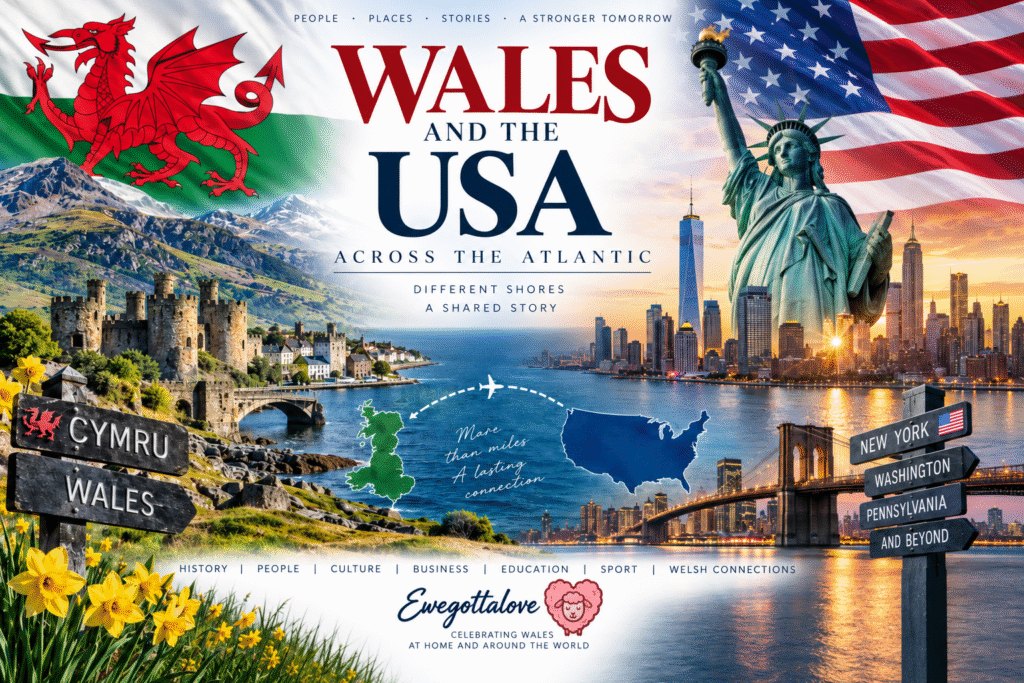
Welsh settlers helped establish communities in colonial America. Welsh miners carried their skills into the coalfields of Pennsylvania and Ohio. Generations maintained their language through chapels, newspapers and eisteddfodau, while some of the most familiar names in American history have discovered Welsh branches in their family trees.
Today the relationship looks very different but remains remarkably strong.
American businesses invest in Wales. Welsh companies sell into the United States. Universities collaborate across the Atlantic. Welsh culture is celebrated at festivals thousands of miles from Cymru – and, thanks to the remarkable story of Wrexham AFC, a new generation of Americans has discovered Wales through football.
The Welsh-American story is far from over.
***
The first Welsh footsteps in America
There is even a Welsh legend claiming that the story began centuries before Columbus.
According to the tale, Prince Madoc sailed west from Wales in around 1170 and reached America. Later versions of the story suggested that his followers encountered Native Americans and that traces of the Welsh language survived among them.
There is no historical evidence demonstrating that Madoc reached America, and the story belongs firmly in the realms of Welsh legend. It nevertheless became influential enough for the Welsh explorer John Evans to travel through North America during the 1790s searching for supposedly Welsh-speaking members of the Mandan people. He found no evidence of such a community.
The documented connection begins much more firmly in the 17th Century.
***
Early Settlers and the Welsh Tract
During the 1680s, Welsh Quakers were among those who crossed the Atlantic to settle in William Penn’s new colony of Pennsylvania.
Land bought by Welsh Quakers developed into what became known as the Welsh Tract, and surviving indentures dating from the 1680s record sales to settlers from communities across Wales. The National Library of Wales describes the documents as an important record of one of the earliest generations of Welsh settlement in North America.
Their presence remains visible in American place names.
Bryn Mawr, Bala Cynwyd, Narberth, Merion and Gwynedd are among the names around Pennsylvania that would look perfectly at home on a Welsh road sign.
Other Welsh communities subsequently developed across the United States, including Cambria County in Pennsylvania, settlements in New York and Wisconsin, and parts of Ohio where immigration from West Wales became particularly strong.
***
From the Valleys to the American coalfields
During the industrial era another major wave crossed the Atlantic.
Welsh miners, engineers and ironworkers carried skills learned in the expanding industries of Wales into America’s developing coal and industrial regions.
Pennsylvania and Ohio became particularly important destinations. Museum Wales records that Scranton developed into one of the largest concentrations of Welsh people outside Wales, while Welsh mining communities established chapels, eisteddfodau and Welsh-language institutions around the American coalfields.
Families followed relatives and neighbours across the Atlantic. Communities with familiar Welsh surnames – Jones, Evans, Davies, Williams, Thomas and Morgan among them – became established thousands of miles from the places from which their ancestors had departed.
Some migrants went in search of land.
Others followed work.
Many carried Wales with them.

READ: Ryder Cup Golf Comes to Wales
America once had a Welsh-language press
One of the most striking signs of the strength of those communities was the growth of Welsh-language publishing.
The National Library of Wales records 21 newspapers serving Welsh communities in America between 1832 and the 1920s.
Titles included Y Cymro Americanaidd, Y Wasg and Colomen Columbia.
The most successful was Y Drych Americanaidd – The American Mirror, founded in New York in 1851. It became the principal newspaper of Welsh America and continued publishing in Welsh into the 20th Century.
The newspaper was part of a much wider cultural world of Welsh chapels, choirs, literature and eisteddfodau.
Even Wisconsin’s state constitution was translated into Welsh as the state’s Welsh immigrant population expanded.
***
Welsh roots in American history
Welsh ancestry also appears repeatedly in America’s political history.
At least eight US Presidents have been identified as having Welsh ancestry, among them John Adams, John Quincy Adams, Thomas Jefferson, James Madison, James Monroe, William Henry Harrison, Abraham Lincoln and Barack Obama.
Abraham Lincoln’s Welsh connection is particularly fascinating.
His great-great-grandfather John Morris was associated with Ysbyty Ifan in north Wales, and during Lincoln’s 1860 presidential campaign around 100,000 campaign pamphlets were printed in Welsh, reflecting the importance of Welsh-speaking voters in parts of America.
In 2014, Barack Obama became the first sitting US President to visit Wales when he attended the NATO summit centred on Newport’s Celtic Manor Resort.
The connections stretch beyond Presidents. Welsh ancestry can be found among influential Americans in fields ranging from finance and architecture to entertainment and public life.
***
A remarkable peace mission from Wales to America
One of the most powerful Welsh-American stories came not through migration but through women campaigning for peace.
In 1923, 390,296 women in Wales signed a peace petition calling on women in the United States to work alongside them in the cause of international peace.
A Welsh delegation led by Annie Jane Hughes-Griffiths travelled to America and presented the appeal in Washington in 1924.
Almost a century later, the petition returned to Wales from the Smithsonian’s National Museum of American History.
It is one of the more extraordinary examples of ordinary Welsh people attempting to build a direct relationship with their counterparts across the Atlantic.
***
When America came to Wales

The movement has never been entirely one way.
During the Second World War, thousands of American servicemen passed through Wales.
US troops lived and trained in Welsh communities, attended dances and formed friendships and relationships with local people. American forces preparing for the D-Day invasion trained on Horton Beach on the Gower Peninsula, while General Dwight Eisenhower visited American troops stationed in west Wales.
Other Americans arrived for very different reasons.
Aviation pioneer Amelia Earhart landed near Burry Port in 1928 after becoming the first woman to cross the Atlantic by aeroplane as a passenger.
American newspaper magnate William Randolph Hearst bought St Donat’s Castle in the Vale of Glamorgan, turning it into an extraordinary transatlantic retreat whose visitors included figures from Hollywood and American society.
St Donat’s later became the home of UWC Atlantic College – giving the American-Welsh story yet another chapter.
***
Wrexham – the extraordinary modern connection
Few could have predicted that one of the most powerful Welsh-American cultural connections of the 21st Century would begin with a struggling football club in north Wales.
American actor Rob McElhenney and Canadian actor Ryan Reynolds completed their takeover of Wrexham AFC in 2021.
Then came Welcome to Wrexham.
What began as an unlikely football documentary introduced millions of viewers – particularly in the United States – not simply to the club but to Wrexham, Welsh culture and even the Welsh language.
American supporters began travelling to north Wales to watch matches at the Racecourse, visit the Turf and explore the city and surrounding region.
By 2026, the programme had become an international phenomenon, while Wrexham’s rise through the football pyramid had given the city a profile unimaginable only a few years earlier. BBC Sport described the documentary as having transformed the club into a global brand.
Perhaps most significantly, Welcome to Wrexham has introduced many Americans to the idea of Wales as a nation in its own right.
Football became the doorway.
Wales became the story.
***
Welsh culture is still alive in North America
Long-established Welsh-American organisations continue to maintain those cultural links.
The North American Festival of Wales traces its origins to a gathering at Niagara Falls in 1929 attended by more than 4,000 people. Today the annual festival moves between locations in the United States and Canada and celebrates Welsh music, language, heritage and community.
Welsh societies also survive in cities including Philadelphia, New York, Washington and Chicago.
Meanwhile, Welsh Government offices in Atlanta, Chicago, Los Angeles, New York and Washington DC promote trade, investment, tourism, education and cultural links with the United States.
***
Business across the Atlantic
The modern relationship is increasingly economic as well as cultural.
The United States is one of Wales’ most important trading partners. Welsh Government figures published in 2026 said more than 1,000 Welsh companies export to the United States, with Welsh goods exports excluding oil worth around £2.1 billion in the year to September 2025.
American investment is also visible in Wales.
US semiconductor company Cadence Design Systems announced a new design centre in Cardiff expected to create more than 100 highly skilled jobs, while other American technology companies have invested in south Wales’s growing semiconductor cluster.
Universities are another increasingly important bridge, with research relationships linking Welsh institutions to universities including Arizona State, Michigan Tech, Brigham Young University and the University of North Carolina.
***
Wales mission to America – 2026
The relationship received fresh attention as the United States marked its 250th anniversary in 2026.

A Welsh Government mission to New York, Washington DC and Massachusetts combined culture, trade, technology and Welsh-American heritage.
Welsh representatives met businesses and cultural organisations, presented a specially commissioned musical gift at the Library of Congress, met members of the bipartisan Friends of Wales Caucus on Capitol Hill and attended the North American Festival of Wales.
In New York, Welsh actor Matthew Rhys participated in discussions about promoting Welsh arts and creativity in America.
It was another reminder that the Wales–USA connection is not simply something preserved in family trees.
It is still developing.
***
From Tom Cruise to Donny Osmond – the unexpected Welsh connections
And then there are the stories that don’t quite fit into official history.
Hollywood star Tom Cruise has Welsh ancestry associated with Flint. Donny Osmond has explored family roots in south Wales and visited Merthyr Tydfil in search of his ancestors. Comedian Bob Hope’s mother came from Barry, while Hope himself later returned to the town to explore his family history.
Hillary Clinton’s Welsh family story includes a coal-mining great-grandfather from Llangynidr who emigrated to Pennsylvania. Her relationship with Swansea University subsequently developed into something much more substantial, and she and former President Bill Clinton appeared together at the university in 2023. The Clintons are famous attendees of The Hay Festival of Literature & Arts, an annual event held in Hay-on-Wye, Powys, Wales. In 2001, Bill Clinton described the festival as “The Woodstock of the mind”.
Even Hollywood comedy legends Laurel and Hardy brought their stage tours through Wales, playing venues including Cardiff, Swansea and Rhyl during their later British touring years.
***
One ocean – hundreds of stories
The relationship between Wales and the United States is difficult to reduce to a single story because it has never been just one relationship.
It is the story of Quakers crossing the Atlantic in the 1680s.
Of miners leaving the Welsh coalfields for Pennsylvania and Ohio.
Of Welsh newspapers appearing in American cities.
Of women carrying a peace petition to Washington.
Of American soldiers preparing for D-Day on a beach in Gower.
Of Hollywood stars discovering Welsh ancestors.
Of American businesses investing in modern Wales.
And of football supporters thousands of miles away suddenly learning to say Wrecsam.
The Atlantic may separate Wales and America geographically.
History has spent centuries bringing them together.
***
Did Ewe Know?
Welsh influence was once so visible around Philadelphia that communities still carry names such as Bryn Mawr, Bala Cynwyd, Gwynedd and Narberth – names transported across the Atlantic by generations whose connection with Wales remains visible on American maps today.
CHICAGO BEARS TAKE WELSH CASTLE BY STORM