
Water Sports in Wales
FEW countries of Wales’ size can offer quite such a varied playground for water sport.
The Atlantic rolls into the beaches of Pembrokeshire, Gower and the Llŷn Peninsula. The Menai Strait provides one of Britain’s great sailing environments. Rivers tumble out of the Welsh mountains, reservoirs and lakes provide sheltered water for beginners and competitors, while Cardiff even has white water on demand.
Wales is a country where you can surf an Atlantic swell, race a yacht, paddle a sea kayak beneath towering cliffs, take on rapids, row across open sea, swim a mountain lake, fly across the water on a foil or experience the speed of a powerboat – sometimes within the same weekend.

Water sport in Wales stretches from recreation and adventure tourism to Olympic and Paralympic competition, with national governing bodies supporting sailing, paddlesport, rowing, surfing and aquatic disciplines.
Sailing and Yachting
Wales has a proud sailing tradition, from small dinghies and junior racing to cruising yachts and international competition.
The Menai Strait is one of its great centres. Plas Menai, the National Outdoor Centre for Wales, sits alongside the Strait and provides a base for sailing, windsurfing, kayaking and powerboating. Elsewhere, sailing clubs stretch from Anglesey and Conwy around Cardigan Bay and Pembrokeshire to Swansea, the Vale of Glamorgan and Cardiff.
RYA Cymru Wales supports around 70 recognised training centres across Wales, while the Welsh sailing pathway includes centres at Port Dinorwic, Llandegfedd, Cardiff Bay and Neyland. Young sailors can progress into the Welsh National Sailing Team and potentially towards international competition.
No Welsh sailor has provided greater inspiration than Hannah Mills. Born in Cardiff and introduced to sailing as a child at Llanishen Reservoir, Mills won Olympic silver at London 2012 followed by gold medals at Rio 2016 and Tokyo 2020, becoming the most successful female Olympic sailor in history.
But sailing need not be about medals. Wales has an extensive club scene built around dinghy racing, yacht racing, cruising, training and simply enjoying being on the water.
Surfing and Bodyboarding
Surf culture is firmly established in Wales.
Llangennith on Gower, Freshwater West, Whitesands and Newgale in Pembrokeshire, Rest Bay at Porthcawl, Porth Neigwl on the Llŷn Peninsula and beaches around Anglesey are among the names familiar to generations of Welsh surfers.
The Welsh Surfing Federation, established in 1973, is the national governing body for surfing in Wales and fields Welsh teams in international competition. Junior competition continues to develop the next generation of Welsh surfers.
Surfing is also one of those sports where the recreational side is every bit as important as elite competition. Surf schools around the coast have introduced thousands of people to the waves, while bodyboarding provides an even more accessible introduction to the Atlantic.
Windsurfing, Kitesurfing and Foiling
Where there are waves and Welsh wind, there are inevitably sails and kites.
Rhosneigr, Abersoch, the Menai Strait, Pembrokeshire and parts of South Wales have developed strong reputations for windsurfing and other wind-powered water sports. North Wales in particular has produced leading figures in British windsurfing, while Plas Menai remains an important training centre.
Kitesurfing has added another spectacular dimension, with riders using the strong coastal winds to generate extraordinary speed and height. More recently, wingfoiling has joined the family, combining a hand-held inflatable wing with a hydrofoil board which rises above the surface of the water.
These rapidly developing disciplines make this one of the areas of Welsh sport worth watching as equipment and technology continue to evolve.
Canoeing, Kayaking & Stand-up Paddleboarding
Few activities reveal Wales from quite the same perspective as paddling.
Paddle Cymru is the national governing body for paddlesport in Wales, covering activities including canoeing, kayaking, stand-up paddleboarding, slalom, sprint, marathon, freestyle, canoe polo, surf kayaking, ocean racing and wild-water racing.
For recreational paddlers there are peaceful stretches of canal, lakes and reservoirs; long river journeys; estuaries rich in wildlife; and some of Britain’s finest sea-kayaking around Pembrokeshire, Anglesey and the Llŷn Peninsula.
For those wanting something considerably faster, Wales also possesses outstanding white-water locations.
Canolfan Tryweryn, the National White Water Centre near Bala, has long been a major destination for rafting and kayaking, while Cardiff International White Water brought an artificial, controllable white-water course into the heart of the Welsh capital. Cardiff’s facility offers rafting, kayaking, stand-up paddleboarding, tubing and indoor wave activities and was Britain’s first on-demand white-water facility.
Llandysul on the River Teifi is another important paddlesport centre, while Wales’s rivers have helped develop generations of competitive canoeists and kayakers.
Rowing – River, Sea and Beach
Welsh rowing is far broader than the traditional image of racing shells on still water.
Welsh Rowing governs river, sea, indoor and para rowing and works to develop competitors capable of progressing to Great Britain squads.
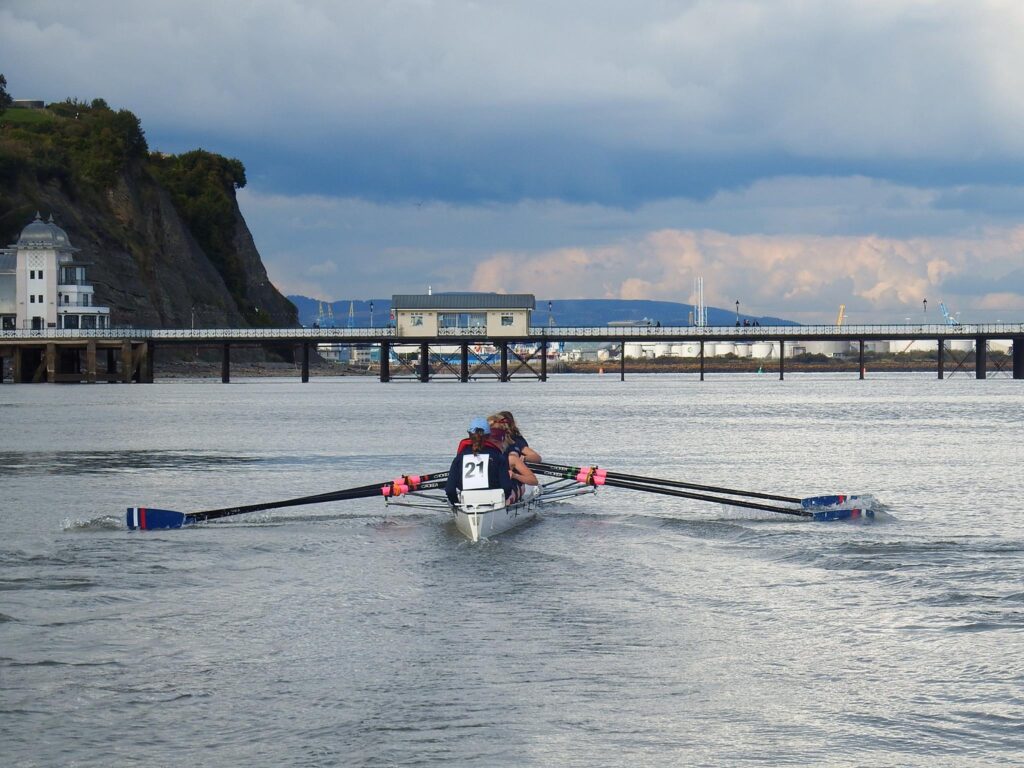
Coastal rowing has a particularly Welsh character. Traditional Celtic longboats, carrying four rowers and a cox, can be found around the coast, with more than 100 boats in Wales. Competitions range from relatively short Welsh League races to the remarkable Celtic Challenge – an open-sea race of more than 90 miles between Arklow in Ireland and Aberystwyth.
Wales has also produced success at the very highest level. Swansea’s Benjamin Pritchard became Paralympic champion in the PR1 single sculls at Paris 2024, having originally discovered rowing during rehabilitation following a cycling accident.
Open Water Swimming
Swimming does not end at the side of the pool.
Wales’ lakes, reservoirs and coastline have helped fuel the growth of open-water swimming, ranging from informal recreational dips to organised events and Olympic marathon competition.
Welsh swimmers have made a major international impact. David Davies won silver in the inaugural Olympic 10km marathon swimming event at Beijing 2008, while Wrexham-born Hector Pardoe represented Great Britain at both Tokyo and Paris, finishing sixth in the 10km race at Paris 2024.
Open-water swimming demands respect for changing weather, tides and cold water, and Swim Wales advises swimmers to check conditions, use suitable visibility equipment and avoid swimming alone.
Diving, High Diving and Welsh Aquatics
The wider Welsh aquatic family also includes diving, water polo and artistic swimming under the Swim Wales umbrella.
One particularly spectacular Welsh success story is Aidan Heslop. The Welsh international became men’s 27-metre high-diving world champion in Doha in 2024 and also won the 2024 Red Bull Cliff Diving World Series. After missing 2025 following back surgery, he returned to win again on the international circuit in 2026.
It is a dramatic reminder that Welsh achievement on the water now extends far beyond the more traditional aquatic sports.
Powerboating and Speed on the Water
Powerboating deserves its place in the Welsh story too.
Today it encompasses everything from RYA powerboat training and safety boats to recreational motor boating and high-speed RIB experiences. The Menai Strait is particularly well known for fast RIB trips through a remarkable tidal environment, while power and sail craft remain part of the boating culture of areas such as Conwy.
Wales also possesses a remarkable powerboat racing heritage.
Jonathan Jones of Cardigan became one of the greatest competitors in Formula One powerboat racing, winning the world championship four times – in 1985, 1989, 1991 and 1998. His career began after watching the annual speedboat races in Cardigan Bay, eventually taking him to the very top of an international sport in which boats could reach around 140mph.
It is one of the lesser-known chapters of Welsh sporting history and one that deserves to be remembered.
Water skiing, wakeboarding, wakesurfing and kneeboarding add still more possibilities, with both boat-towed and cable disciplines providing another route into competitive and recreational water sport.
Coasteering – A Welsh Invention
And then there is a water sport that Wales can genuinely claim as one of its own.
Coasteering was pioneered on the Pembrokeshire coast during the 1980s. Instead of travelling along a coast by footpath, participants make their way through the intertidal zone itself – swimming, scrambling over rocks, entering caves, riding swells and, where appropriate, jumping into the sea.
From its Pembrokeshire beginnings it has spread around Britain and internationally, but Wales remains its spiritual home. Pembrokeshire, Gower, the Vale of Glamorgan, Anglesey and the Llŷn Peninsula now offer some outstanding coasteering locations.
It is perhaps the perfect Welsh water sport: part adventure, part exploration and completely dependent upon the country’s dramatic coastline.
From Mountains to the Sea
What makes Wales particularly special for water sport is not any one discipline but the variety.
North Wales offers the Menai Strait, Anglesey, Bala and some of the country’s finest white water. Ceredigion and the Teifi have a long paddling tradition. Pembrokeshire combines surfing, sailing, kayaking, coasteering, open-water swimming and rowing with Britain’s only coastal National Park. Gower brings together surfing, sailing and coastal adventure. South-east Wales adds reservoirs, the Bristol Channel, Cardiff Bay and one of Britain’s leading artificial white-water centres.
The result is a sporting landscape in which grassroots participation, tourism, adventure and elite performance frequently overlap.
A child having a first sailing lesson could be following the route once taken by Hannah Mills. Someone climbing into a rowing boat in Swansea could be inspired by Benjamin Pritchard. A youngster trying open-water swimming has David Davies and Hector Pardoe to follow. A family experiencing coasteering in Pembrokeshire is taking part in an adventure sport that began here in Wales.
And somewhere on Cardigan Bay, there may yet be another youngster watching fast boats and dreaming of becoming the next Jonathan Jones.
Did Ewe Know?
Pembrokeshire did not just help invent coasteering. In 2022, Saundersfoot hosted both the World Rowing Coastal Championships and the World Rowing Beach Sprint Finals, with more than 540 rowers from countries as far apart as New Zealand, Peru, Japan and the United States entering the Coastal Championships.