
Billy Boston
FEW Welsh sportsmen have left a legacy quite like Sir Billy Boston.
Born in Cardiff’s Tiger Bay, Boston travelled north as a teenager and became not simply one of rugby league’s greatest-ever players, but a sporting pioneer who broke records, crossed racial barriers and became a hero in two cities more than 150 miles apart.
When he died in August 2026 at the age of 92, rugby league lost one of the defining figures in its history.
But Cardiff lost one of its own too.
William John Boston was born in Butetown, Cardiff, on 6 August 1934, the sixth of 11 children of John, who came from Sierra Leone, and Nellie, who was Irish.
Growing up amid the extraordinary multicultural community of Tiger Bay, Billy attended South Church Street School and displayed exceptional athletic ability from an early age.
By 16 he was starring for Cardiff International Athletic Club, the famous CIACS club established by young people and former servicemen from the docks community. He also represented Cardiff Schools and Wales at youth level in rugby union and played briefly for Neath.
Yet his future would be found in the 13-man code.
In 1953, while Boston was still a teenager, officials from Wigan Rugby League Club travelled to the family home in Angelina Street and persuaded him to sign professionally for £3,000 — an enormous sum for a young working-class sportsman at the time.
It proved one of the greatest signings Wigan ever made.
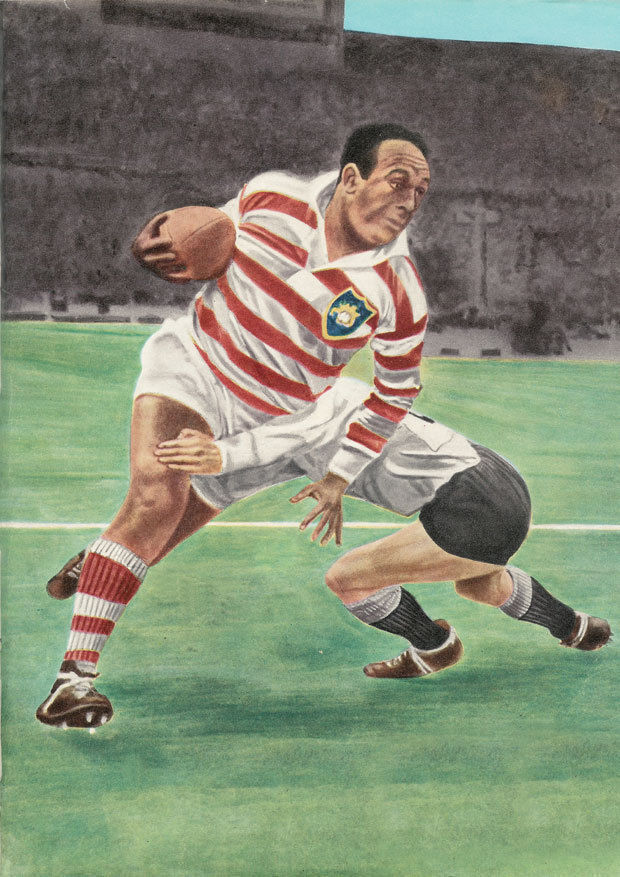
Boston combined extraordinary acceleration with immense physical power. Although generally associated with the wing, he possessed the strength of a forward and the finishing instincts of a natural try-scorer.
The statistics remain astonishing.
During 15 seasons with Wigan he scored 478 tries in 488 appearances, a club record which still stands. He scored three or more tries in a match on 51 occasions and once crossed for an extraordinary 60 tries in a single season.
With Boston in the side, Wigan won the Challenge Cup three times, as well as the league championship and numerous Lancashire honours.
His impact stretched far beyond club rugby.
In 1954 Boston became the first non-white player selected for a Great Britain Rugby League Lions tour of Australia and New Zealand. Still only 20, he scored a record 36 tries in 18 matches on the tour.
He later returned Down Under with the Lions in 1962.
Boston scored 24 tries in 31 Great Britain Test appearances and helped the side win the 1960 Rugby League World Cup, scoring in the decisive victory over Australia. He was also part of three Ashes-winning campaigns.
Across his entire rugby league career he scored 571 tries, making him the most prolific British try-scorer in the history of the sport. Only Australian-born Brian Bevan scored more.
But Boston’s importance cannot be measured by statistics alone.
He succeeded at a time when black sportsmen faced overt racial prejudice, and his achievements helped challenge attitudes both inside and outside sport.
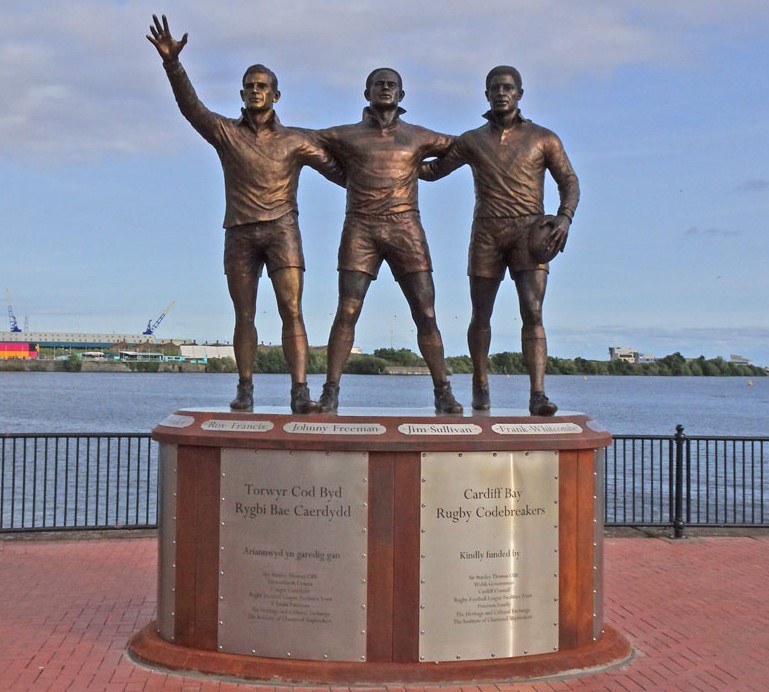
His move north also placed him among a remarkable generation of players from Cardiff’s docklands communities who became known as the Rugby Codebreakers — men who left rugby union in Wales to build extraordinary careers in professional rugby league.
Boston never forgot where he came from.
And Cardiff eventually made sure it did not forget him.
In July 2023 a bronze monument to Billy Boston, Clive Sullivan and Gus Risman was unveiled at Landsea Square in Cardiff Bay. Created by sculptor Steve Winterburn, the Rugby Codebreakers monument became the first statue in Wales depicting named, non-fictionalised black men.
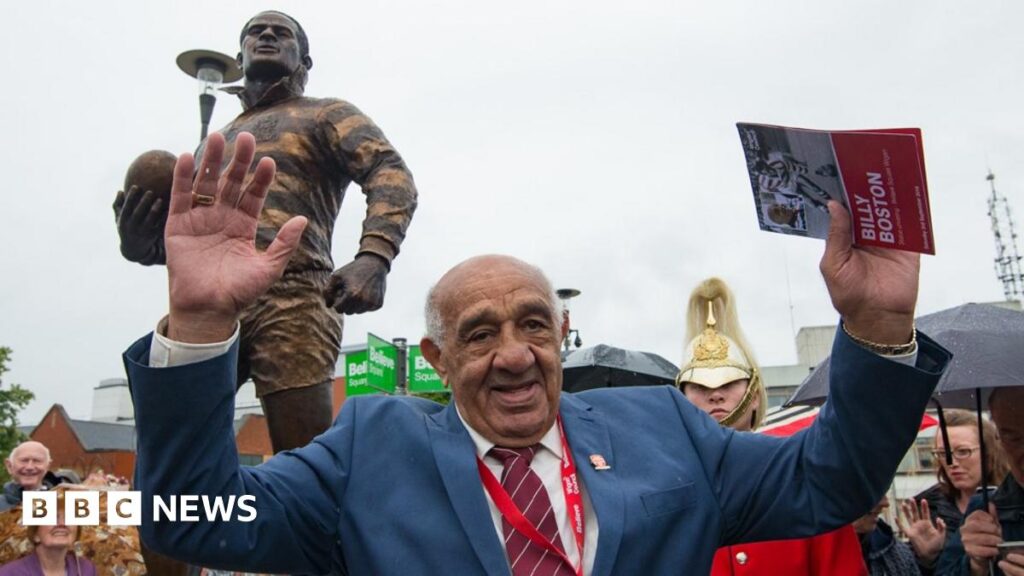
Boston, then aged 88, was able to attend the unveiling.
He already had statues associated with him elsewhere. He is one of five rugby league legends commemorated outside Wembley Stadium, while another statue stands in Wigan, the town where he spent most of his adult life.
Yet one final honour remained.
In June 2025, at the age of 90, Billy Boston became the first rugby league player ever to receive a knighthood.
King Charles III knighted him at Buckingham Palace for services to Rugby League Football. The investiture was brought forward because of concerns about Boston’s health, and his family later recalled how deeply proud he was of the recognition.
Later that year, the plaque on Cardiff Bay’s Rugby Codebreakers statue was changed to carry his new title: Sir William John Boston KBE.
It proved a particularly poignant final chapter.
Sir Billy’s wife Lady Joan, to whom he had been married for 70 years, died during the summer of 2026.
Only weeks later, on 24 August 2026, Sir Billy Boston died peacefully at the age of 92, surrounded by his family.
The response demonstrated just how far his influence had travelled.
Tributes came from across rugby league and British sport. Wigan opened a book of condolence and later held his funeral at the club’s Brick Community Stadium, allowing supporters to say goodbye to a man whose name had become inseparable from theirs.
His honours include membership of the Rugby League Hall of Fame, recognition by the Welsh Sports Hall of Fame, the BBC Wales lifetime achievement award and statues in Cardiff, Wigan and at Wembley.
But perhaps his greatest legacy can be found in the journey itself.
From Angelina Street in Tiger Bay to Wembley.
From a young black Welsh rugby player confronting the prejudices of the 1950s to becoming one of the greatest athletes his sport had seen.
From Billy Boston of Cardiff to Sir Billy Boston KBE.
Wigan rightly regarded him as one of their greatest sons.
Wales should regard him the same way.
Sir Billy Boston – 1934–2026. A Cardiff boy, a Wigan legend and a genuine pioneer of British sport.