
The Millennium Falcon: The Story of Star Wars’ Most Famous Spaceship
THERE are spaceships in science fiction that look sleek, futuristic and impossibly advanced.
And then there is the Millennium Falcon.
Battered, temperamental, frequently described as junk and seemingly held together by equal parts engineering and optimism, Han Solo’s beloved ship became one of the most recognisable objects in cinema.
For generations of Star Wars fans, its circular hull, forward mandibles and off-centre cockpit have been as instantly identifiable as Darth Vader’s helmet or a lightsaber.
But the story behind the Millennium Falcon is almost as entertaining as anything that happened aboard it.
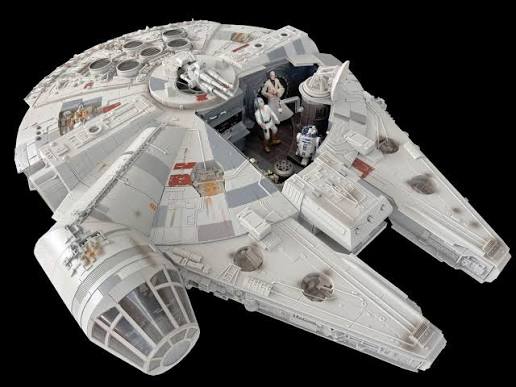
Its design was changed at remarkable speed. Models were created in different sizes. Enormous practical sets were constructed. Toys turned it into a childhood icon.
And one of the biggest versions of all was secretly built in a former dockyard far, far away in a coastal corner of the United Kingdom.
***
What exactly is the Millennium Falcon?
Within the Star Wars universe, the Falcon began life as a Corellian light freighter before successive owners modified it far beyond its original specifications.
It was owned by Lando Calrissian before eventually passing to Han Solo, who won the ship from Lando in a game of sabacc.
Han and Chewbacca then turned it into both their workplace and their home.
It did not look particularly impressive.
Luke Skywalker certainly wasn’t impressed when he first encountered it on Tatooine.
But underneath the scarred exterior was a remarkably fast and heavily modified ship capable of escaping Imperial forces, surviving asteroid fields and participating in some of the decisive battles of the Galactic Civil War.
The Falcon helped Han and Chewbacca assist Luke during the destruction of the first Death Star and later carried Lando Calrissian into the second Death Star during the Battle of Endor.
Not bad for a battered old freighter.
***
Was the Millennium Falcon really inspired by a hamburger?
One of the most repeated stories about the Millennium Falcon is that its shape was inspired by a hamburger with an olive beside it.
The truth appears to be slightly more complicated – and perhaps even better.
The original design for Han Solo’s ship looked very different. However, the production team felt it resembled spacecraft in the television series Space: 1999, so a radical redesign was required.
Designer Joe Johnston later recalled taking elements such as the cockpit from the earlier concept and attaching them to a large dish-shaped body with the distinctive forward mandibles.
According to a later Lucasfilm account, Johnston also remembered seeing stacked dirty plates at home and imagining two plates sandwiched together.
The famous Falcon silhouette emerged remarkably quickly.
What began as a hurried redesign became one of the most recognisable spacecraft ever created.
***
A spaceship that looked used
Part of the Falcon’s appeal was that it didn’t look new.
George Lucas’s original Star Wars universe felt different from much earlier science fiction because machinery looked as though people actually lived and worked with it.
Panels were dirty.
Paint was chipped.
Things broke.
The Falcon represented that philosophy perfectly.
This was not an immaculate spacecraft displayed in a showroom. It was closer to an old car owned by someone who had modified the engine, ignored the bodywork and knew exactly which part of the dashboard needed hitting when something stopped working.
That imperfection also helped give the ship personality.
Its hyperdrive fails at inconvenient moments. Systems require constant attention. Han talks about the Falcon almost as though it were another member of the crew.
In many ways, it is.
***
Models, sets and movie magic
Creating the Falcon on screen required several completely different versions.
For the original Star Wars, the production used detailed miniature models alongside full-size interior and partial exterior sets.
Industrial Light & Magic’s early motion-control camera system allowed models such as the Falcon to appear to fly through space while maintaining precisely repeatable camera movements – an important part of the visual-effects revolution created for the original film.
For The Empire Strikes Back, different models allowed the ship to perform increasingly ambitious manoeuvres, including its famous escape through an asteroid field.
But the filmmakers also wanted something considerably larger.
Much larger.
***
The Millennium Falcon’s surprising Welsh connection
In 1979, engineers working at Pembroke Dock in west Wales were given an unusual assignment.
They had to build a full-size Millennium Falcon.
The work was undertaken by Marcon Fabrications, a company more accustomed to industrial engineering than constructing spaceships for Hollywood.
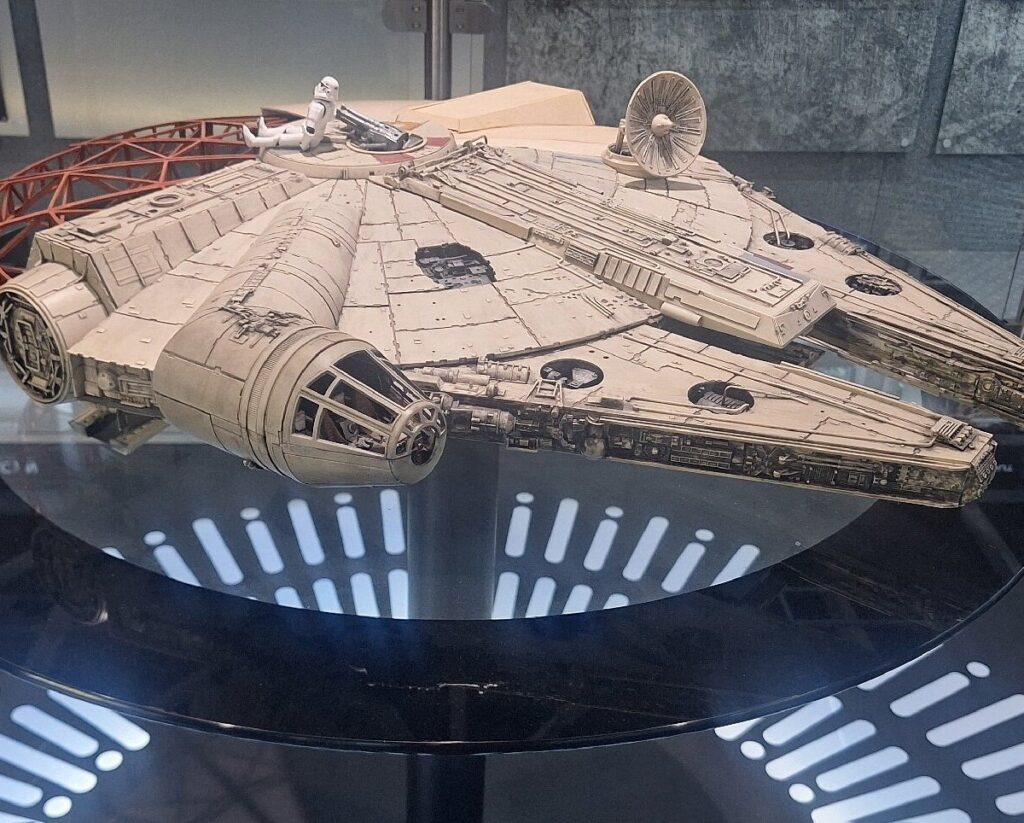
Around 30 to 40 local craftspeople worked on the enormous structure, which measured more than 80 feet long and weighed around 23 tonnes.
And because the production was supposed to remain secret, the project acquired the wonderfully unlikely codename: Magic Roundabout (most likely a nod to a well-known British children’s programme of the time).
Keeping an 80-foot spaceship secret in Pembrokeshire proved challenging.
Rumours spread locally about the mysterious object being constructed inside the former flying-boat hangar.
Once completed, the Falcon was dismantled into sections, transported from Wales to Elstree Studios and reassembled for filming on The Empire Strikes Back.
Today Pembroke Dock Heritage Centre maintains a permanent exhibition about the project, including photographs, models and material telling the story of the Welsh engineers who helped create one of cinema’s most famous spacecraft.
DISCOVER THE FULL WELSH STORY
Want to know why a Hollywood spaceship was being secretly constructed in a Pembrokeshire dockyard?
***
Lando’s Falcon was very different
When Solo: A Star Wars Story returned to an earlier period in the Falcon’s life, its designers faced an unusual challenge.
Audiences knew what Han Solo’s battered Falcon looked like.
But what had it looked like when the much more style-conscious Lando Calrissian owned it?
Lucasfilm’s design team explored around 60 different iterations before settling on the cleaner version seen in the film.
The result was deliberately more pristine and luxurious than Han’s later ship, including cleaner exterior panelling and an escape craft filling the familiar gap between the forward mandibles. The events of the Kessel Run then help explain how Lando’s immaculate Falcon gradually becomes the battered vessel audiences know from the original trilogy.
It is essentially the same spaceship before Han Solo got his hands on it.
***
The ship that made the Kessel Run
No discussion of the Falcon would be complete without one of Han Solo’s favourite boasts.
He tells Obi-Wan Kenobi that the Falcon made the Kessel Run in less than 12 parsecs.
The line puzzled generations of viewers because a parsec measures distance rather than time.
Solo: A Star Wars Story eventually depicted the celebrated journey, showing Han taking an exceptionally dangerous shortcut through the Kessel maelstrom.
The Falcon survives – just – but Lando’s beautifully maintained ship emerges considerably worse for wear.
***
From movie prop to pop-culture icon
The Falcon soon escaped the boundaries of the films themselves.
It became a toy, a model kit, a Lego set, a video-game vehicle, a theme-park attraction and an object reproduced by fans in everything from cardboard to extraordinarily elaborate scale models.
For children who grew up with Star Wars, owning a Millennium Falcon toy often meant having the centrepiece around which every other figure and adventure could revolve.
Its cockpit was instantly familiar.
So was the chess table.
The hidden compartments.
The gun turrets.
Even the pair of dice hanging inside the cockpit developed their own place within Star Wars mythology.
Very few fictional vehicles have become so closely associated with their owners.
James Bond has the Aston Martin.
Batman has the Batmobile.
Han Solo and Chewbacca have the Millennium Falcon.
***
Why has the Millennium Falcon endured?
Perhaps because it never seemed perfect.
The Falcon is fast but unreliable, powerful but battered. Famous, but frequently dismissed by people seeing it for the first time.
And unlike so many fictional spaceships, it feels inhabited.
Han and Chewbacca don’t simply pilot it. They argue with it, repair it, sleep aboard it and repeatedly risk their lives trying to keep it flying.
When Han steps back aboard the Falcon decades later in The Force Awakens, his reaction needs only two words:
The ship feels like home.
And perhaps that is ultimately why audiences have loved the Millennium Falcon for almost half a century.
It might be a spaceship from a galaxy far, far away. But somehow, it has always felt wonderfully familiar.
***
Yougottalove this…
The Millennium Falcon’s famous circular design was not the original design for Han Solo’s ship. That earlier concept was reworked and ultimately evolved into the Tantive IV – the Rebel vessel pursued by Darth Vader’s Star Destroyer in the opening moments of the original Star Wars.