
Y Ddraig Goch: The Dragon at the Heart of Wales
Long before he appeared on flags, rugby shirts and souvenirs, the great Red Dragon of Wales was fighting an ancient enemy beneath the mountains — and helping to create one of the most remarkable national legends in the world
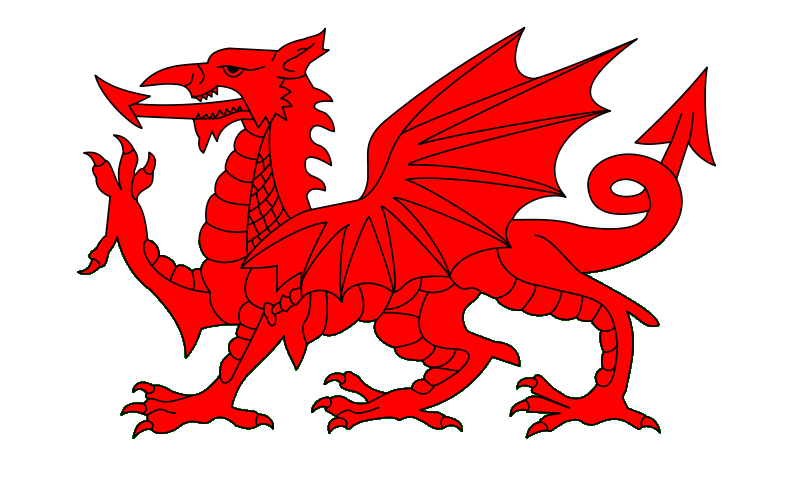
THERE are dragons, and then there is Y Ddraig Goch.
For the Welsh, the great red dragon is far more than a mythical monster. He is a national emblem, a sporting companion, a familiar presence on everything from flags to badges — and probably the only dragon in this project who can reasonably claim to represent an entire country.
His Welsh name, Y Ddraig Goch, simply means ‘The Red Dragon‘, although there is nothing particularly simple about the story that brought him to the centre of Welsh identity.
When two dragons went to war
One of the great Welsh legends tells of two dragons — one red and one white — locked in a terrible struggle.
In the version preserved by Cadw, their fighting caused such devastation that the Welsh king Lludd devised a wonderfully unconventional solution. He prepared a great cauldron of mead, allowed the dragons to drink themselves into submission, wrapped the sleeping creatures in a sheet and buried them beneath Dinas Emrys, in what is now Eryri.
Which makes Y Ddraig Goch quite possibly the first dragon in our series to have been defeated temporarily by excessive refreshment.
But buried dragons have an inconvenient habit of not staying buried.
Centuries later, according to the legend, King Vortigern attempted to build a fortress on Dinas Emrys. Every time his builders erected the walls, they mysteriously collapsed. A young boy associated in later retellings with Merlin revealed the problem: beneath the site lay the two sleeping dragons.
They were released, resumed their battle — and this time the red dragon eventually defeated the white.
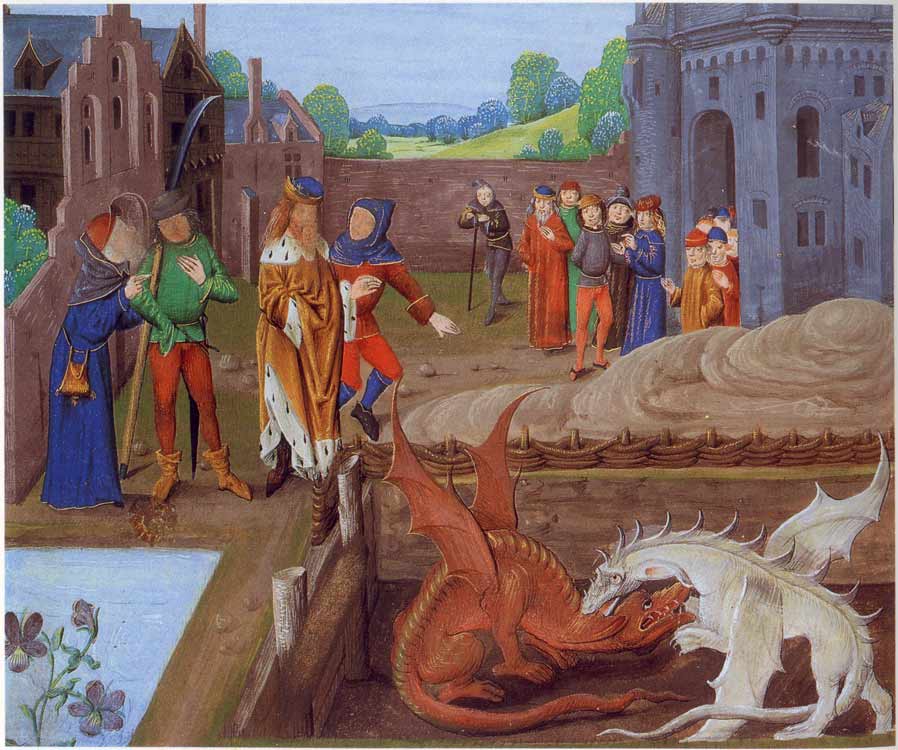
The symbolism was unmistakable. In Geoffrey of Monmouth’s 12th-century Historia Regum Britanniae, the red dragon was interpreted as representing the native Britons and the white dragon their Saxon enemies.
The dragon had become more than a monster.
It had become a prophecy.
***
From legend to national emblem
Dragons had a long history as military symbols before the Welsh story developed. Wales.com notes that dragon standards were used by the Romans and that the emblem was subsequently associated with rulers in post-Roman Britain.
But one particularly important moment came in 1485.
Henry Tudor, who was born at Pembroke Castle and claimed descent from the legendary British king Cadwaladr, used a red dragon during his campaign against Richard III. After Henry’s victory at the Battle of Bosworth, the dragon was displayed against the Tudor colours of green and white — a combination that would eventually become familiar to generations of Welsh people.
Yet the flag as we know it today is surprisingly modern.
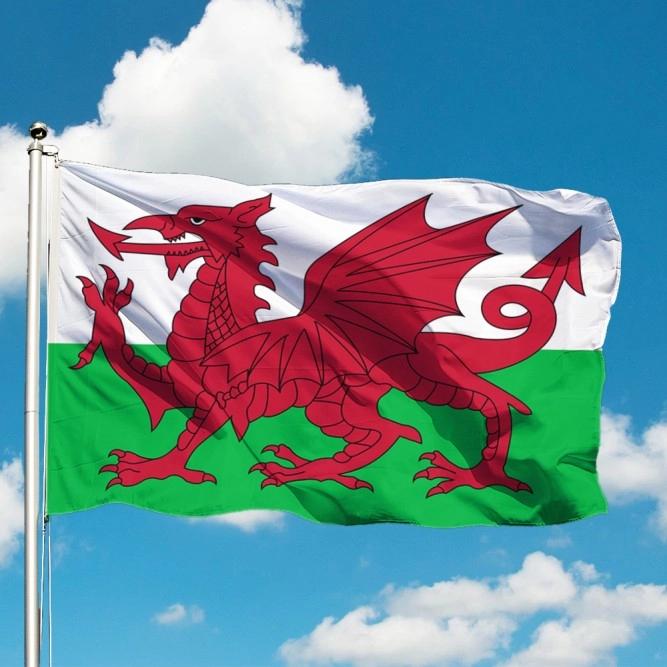
It was only in 1959 that the red dragon on its green-and-white field was officially recognised as the Welsh national flag.
Ancient dragon. Medieval legend. Tudor politics.
Modern flag.
Not bad for one mythical creature.
***
And the dragon still has plenty of fire
Today, Y Ddraig Goch is probably the most instantly recognisable visual symbol of Wales.
He appears at sporting internationals, on buildings and products, at celebrations and wherever Welsh identity is being expressed. Wales’s official tourism site describes the red dragon as having become a symbol seen throughout Welsh towns and cities and on the shirts of national sporting teams.
And perhaps that is the secret of his longevity.
Other legendary dragons were slain by knights, imprisoned in caves or relegated to the pages of old books.
Y Ddraig Goch survived.
More than that, he prospered.
After many centuries of fighting, drinking mead, sleeping beneath mountains and getting involved in dynastic politics, the Red Dragon finally found what must surely be the ultimate job for any dragon:
representing Wales.
Did Ewe Know?
The dragons got drunk: In the Lludd version of the legend, the red and white dragons are subdued by drinking mead before being wrapped up and buried at Dinas Emrys.
The troublesome castle really does have an archaeological setting: Excavation at Dinas Emrys in 1945 uncovered evidence connected with a fortress on the site; Wales.com notes the intriguing correspondence between the archaeology and elements of the later legend.
The dragon predates the present flag by centuries: The modern national flag was formally recognised only in 1959.
Henry Tudor helped turn the dragon into a powerful political symbol: He used the red dragon in 1485 and associated it with the green and white Tudor colours.
Y Ddraig Goch really does mean ‘The Red Dragon’.