
Women in Welsh Sport – Pioneers, Champions and History Makers
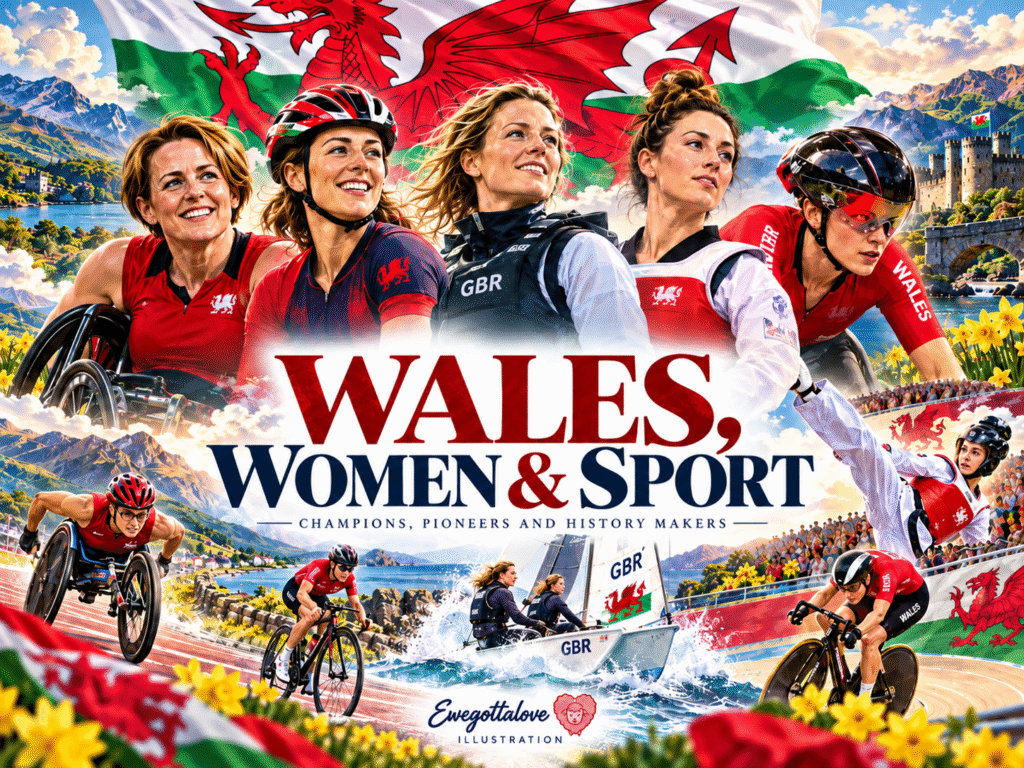
WELSH sporting history is filled with famous names.
For generations, however, far too many of the women who helped create that history received considerably less attention than their male counterparts.
That picture has changed dramatically.
Today Welsh women are Olympic and Paralympic champions, world champions, international footballers and rugby players, record-breaking cyclists, boxers, sailors and athletes. They fill stadiums, headline major events and provide sporting role models for a generation of Welsh girls who can now see considerably more possibilities than those who came before them.
And while the progress has sometimes been painfully slow, the list of Welsh women who have changed their sports is an extraordinary one.
Tanni Grey-Thompson – one of the great Paralympians
Any celebration of women in Welsh sport has to include Baroness Tanni Grey-Thompson.
Born in Cardiff, she began wheelchair racing while attending St Cyres Comprehensive School and developed into one of the most successful Paralympians Britain has ever produced.
Across five Paralympic Games she won 11 gold medals, four silvers and a bronze. At Barcelona in 1992 alone she won four golds, repeating that four-gold achievement at Sydney 2000.
She also won the London Wheelchair Marathon six times before building an equally significant career away from competition as a campaigner, broadcaster and member of the House of Lords.
Long before Paralympic sport enjoyed its current profile, Grey-Thompson was one of the people forcing it into the national consciousness.
Nicole Cooke – cycling pioneer
Welsh women have had an extraordinary impact on cycling.
Nicole Cooke, from Wick in the Vale of Glamorgan, was one of the pioneers.
In 2008 she produced one of the finest seasons achieved by any British cyclist, winning the Olympic road race in Beijing before becoming world road race champion later that year.
She became the first cyclist ever to win the Olympic and World Championship road races in the same year.
Cooke was also Britain’s first female cycling Olympic champion, Britain’s first cycling world number one and the first British rider to win a Grand Tour. Throughout her career she was also a forceful advocate for greater equality in women’s cycling.
A generation later, Welsh cycling is enjoying another remarkable period.
Elinor Barker – Cardiff to the Olympic podium
Elinor Barker, from Cardiff, began cycling with the Maindy Flyers and has become Wales’s most decorated female Olympian.
Barker won team pursuit gold at the Rio 2016 Olympics, silver at Tokyo and then added both silver and bronze at Paris 2024.
Her success extends far beyond the Olympics. She is a multiple world and European champion on the track and has competed successfully on the road as well.
What makes her story even more significant is that Barker returned to elite competition after becoming a mother in 2022 and went on to win further world and Olympic medals.
Emma Finucane – Wales’s newest record-breaker
Then came Emma Finucane.
At the Paris Olympics in 2024 she won team sprint gold alongside Katy Marchant and Sophie Capewell and added bronze medals in both the individual sprint and keirin.
That made her the first British woman for 60 years to win three medals at a single Olympic Games.
And in Glasgow in 2026, she went even further.
Representing Wales at the Commonwealth Games, Finucane won four gold medals — team sprint, individual sprint, 1,000m time trial and keirin.
No sprint cyclist had previously won four track golds at a single Commonwealth Games, and Finucane became the first Welsh woman to win four gold medals at one Games.
For a country which had already produced Nicole Cooke and Elinor Barker, Welsh women’s cycling suddenly had another superstar.
Hannah Mills – queen of the water
Cardiff-born Hannah Mills created history in an entirely different environment.
Mills won Olympic sailing silver at London 2012 before taking gold at Rio 2016 alongside Saskia Clark.
At Tokyo 2020 she won another gold, this time with Eilidh McIntyre, becoming the most successful female sailor in Olympic history with two gold medals and a silver.
She was also selected as one of Team GB’s flag bearers for the Tokyo Opening Ceremony and has subsequently become an influential campaigner on environmental issues within sport.
Jade Jones – the Headhunter from Flint
Few Olympic moments captured Welsh imagination quite like Jade Jones winning taekwondo gold at London 2012.
The 19-year-old from Flint became Britain’s first Olympic taekwondo champion.
Four years later she did it again.
Jones successfully defended her -57kg title at Rio 2016 and later added the world title in 2019. She competed at four Olympic Games, including Paris 2024.
Her success helped turn a relatively unfamiliar Olympic sport into one in which Welsh supporters suddenly had a genuine global star.
Lauren Price – footballer to boxing champion
Lauren Price has perhaps one of the most extraordinary sporting CVs of them all.
Born in Newport and raised in Ystrad Mynach, she represented Wales in football, became a world champion kickboxer and then concentrated on boxing.
At the Tokyo Olympics she became Olympic middleweight champion, the first Welsh boxer to win Olympic gold.
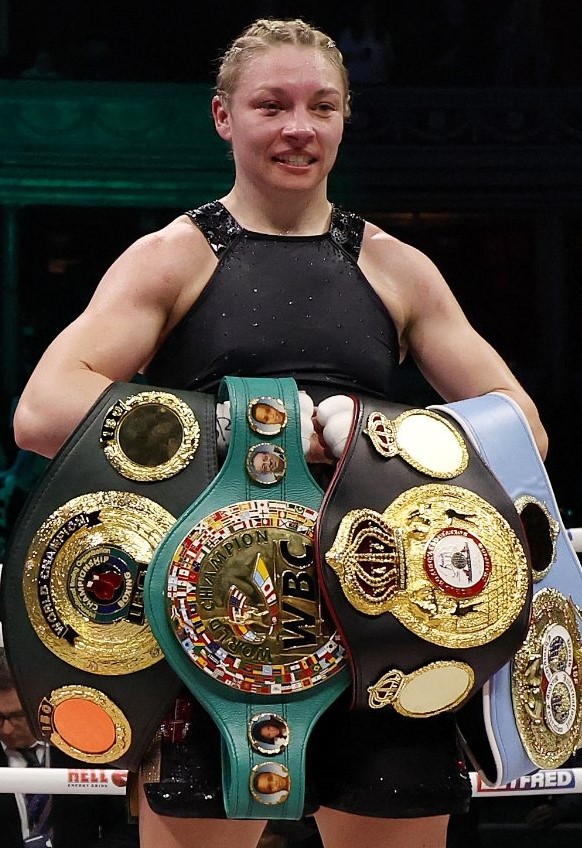
Her professional career has continued to break new ground.
Price became Wales’s first female professional boxing world champion when she defeated Jessica McCaskill in Cardiff in 2024 and subsequently unified the welterweight division.
In April 2026 she successfully defended her WBA, WBC and IBF world titles against Stephanie Pineiro Aquino at Cardiff’s Utilita Arena. Talks have since continued around a potentially enormous fight with American great Claressa Shields.
Lauren Price’s story is still being written.
Wales Women finally reach the big stage
For Welsh women’s football, one date will always stand apart.
In December 2024, Cymru defeated the Republic of Ireland to qualify for UEFA Women’s EURO 2025.
It was the first time the Wales women’s senior team had ever qualified for a major tournament.
Thirty years earlier Wales had entered Women’s EURO qualifying and lost all six games. By 2025, thousands of Welsh supporters were travelling to Switzerland to watch their country take on the Netherlands, France and England.
At the centre of that journey was Jess Fishlock.
Fishlock finished her Wales career as the country’s most capped player and record goalscorer, with 165 appearances and 48 goals. At EURO 2025 she scored Wales’s first goal at a major women’s tournament and, aged 38, became the oldest goalscorer in Women’s EURO finals history.
She retired from international football later in 2025 but has already moved towards the next chapter, completing her UEFA A coaching licence in 2026.
Others have played equally important roles in changing expectations.
Sophie Ingle, who captained Wales for nine years, reached her 150th international appearance in 2026, while Angharad James succeeded her as captain and led the country into its historic first major finals.
For young Welsh girls growing up today, international women’s football is no longer something happening somewhere else.
They have their own national team to follow.
A new era for women’s rugby
Women’s rugby in Wales has undergone its own transformation.
Players who for generations balanced international rugby with jobs and studies are now increasingly able to prepare as professional athletes.
The WRU awarded its first full-time contracts to 12 Wales Women players in 2022. By 2024 that number had risen to 37 professional contracts, with captain Hannah Jones, Jasmine Joyce and other leading internationals among those contracted.
There have been difficult results along the way, but the significance goes far beyond a single Six Nations campaign.
For the first time, girls entering Welsh rugby can realistically aspire to make the sport their profession.
Welsh Paralympic excellence continues
Tanni Grey-Thompson’s achievements have also been followed by another generation of Welsh and Wales-based Para athletes.
Hollie Arnold became Paralympic F46 javelin champion at Rio 2016 and has won six world titles. She added another Paralympic bronze at Paris 2024.
Olivia Breen has won Paralympic, World, European and Commonwealth medals and represented Wales with particular distinction, including Commonwealth gold in both long jump and sprint events during her career. In Glasgow in 2026 she added another Commonwealth T38 long jump gold.
Their successes underline an important point: any story of Welsh women’s sport must include both Olympic and Paralympic achievement.
The story is getting bigger
This is not intended to be a complete roll call.
There are many more women whose achievements deserve recognition — past and present — across athletics, hockey, netball, swimming, gymnastics, bowls, cricket, golf, equestrian sport and countless other disciplines.
Nor should the story be presented as though every barrier has disappeared.
Women’s sport still faces questions around investment, facilities, media coverage, sponsorship, pay and opportunity.
But the direction of travel is unmistakable.
A Welsh girl growing up today can see Lauren Price headlining a world-title fight in Cardiff.
She can watch Wales Women at a European Championship.
She can see Emma Finucane collecting four Commonwealth gold medals.
She can learn about Tanni Grey-Thompson, Nicole Cooke, Hannah Mills, Jade Jones and Elinor Barker becoming some of the finest athletes in the world.
And she can reasonably believe that somebody from Wales can be next.
That may ultimately be the greatest achievement of all.
Women are no longer a footnote in the story of Welsh sport. They are helping write its next chapter.