
Rugby League in Wales
RUGBY LEAGUE may have its traditional heartlands across the north of England, but Wales has played an extraordinary role in the history of the 13-a-side game.
For much of the 20th Century, some of the finest rugby players produced by Welsh towns, valleys and mining communities travelled north to become professionals — a journey so familiar that it became known simply as “going north.”
Many became legends.
Billy Boston, Clive Sullivan, Gus Risman, Jim Sullivan, Lewis Jones and David Watkins are among a remarkable collection of Welshmen who left an enduring mark on rugby league, while later generations included Jonathan Davies, Scott Quinnell, Keiron Cunningham, Lee Briers and Regan Grace.
The result is a Welsh rugby league heritage far greater than the sport’s comparatively modest profile within Wales might suggest.
The Beginning of the Welsh Story
Rugby league was first played formally in Wales in the early years of the 20th Century.
On 1 January 1908, Wales defeated the touring New Zealand side 9–8 at Aberdare in what Wales Rugby League describes as the world’s first official rugby league Test match.
Welsh clubs subsequently entered the Northern Union competitions, while generations of individual Welsh players crossed the border to join professional clubs in England.
For many, there was a straightforward reason.
Until rugby union became openly professional in 1995, rugby league offered talented working-class Welsh players something union officially could not — the opportunity to earn a living from playing rugby.
It created one of the great recurring stories of Welsh sport.
***
Sir Billy Boston – A Giant of the Game
Few Welsh sportsmen have achieved more than Sir Billy Boston.
Born in Cardiff’s Tiger Bay in 1934, Boston joined Wigan and became one of the greatest try-scorers rugby league has ever known.
He scored 571 tries in 564 career appearances, the second-highest recorded total in the history of the sport, and helped Great Britain win the Rugby League World Cup in 1960.
Boston also became one of Britain’s pioneering Black sporting superstars.
In 2025 he became the first person knighted for services to rugby league, becoming Sir William John Boston KBE. He died in August 2026 at the age of 92.
His place among the greatest Welsh sportspeople of all time extends far beyond either code of rugby.
***
Clive Sullivan – World Cup Winning Captain
Another Cardiff-born rugby league great made sporting history of his own.
Clive Sullivan, born in Splott, became the first Black player to captain a British international rugby team when he led Great Britain to victory in the 1972 Rugby League World Cup.
Sullivan scored in every one of Great Britain’s four matches during that tournament, including a crucial try against Australia in the final.
He later captained Wales and became a celebrated figure for both Hull FC and Hull Kingston Rovers.
His achievements were so highly regarded in Hull that one of the city’s principal roads was named Clive Sullivan Way in his honour.
***
Cardiff’s Codebreakers
Boston and Sullivan were not isolated cases.
Cardiff — and particularly the multicultural communities around Tiger Bay, Butetown, Grangetown and the docks — produced an extraordinary collection of rugby league players.
Another was Gus Risman, who captained Great Britain and became one of the game’s all-time greats.
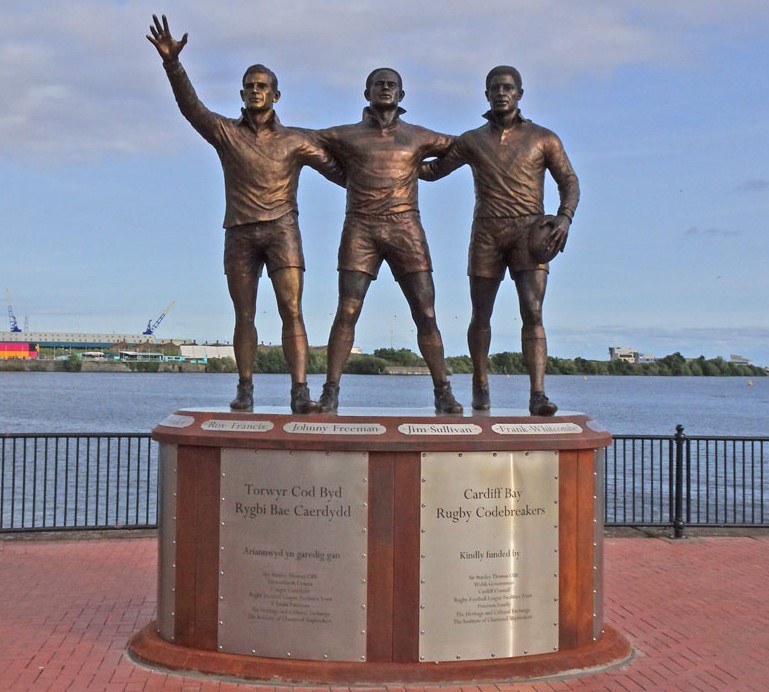
Today Boston, Sullivan and Risman are commemorated by the Codebreakers statue in Cardiff Bay (pictured below), representing not only those three champions but the many Welsh players who travelled north to make their names in rugby league.
Their stories also reveal an important social dimension to rugby league.
For some Black Welsh players, the professional game offered opportunities at a time when racial prejudice restricted their progress elsewhere in British sport. Rugby league consequently occupies an important place in the history of sporting inclusion in Wales.
***
Welsh Legends of Rugby League
The list of outstanding Welsh rugby league players stretches across generations.
Jim Sullivan, from Cardiff, became one of Wigan’s greatest-ever players.
Gus Risman enjoyed a legendary career with Salford and Workington Town.
Lewis Jones became a superstar with Leeds after switching codes.
David Watkins starred for Salford after an outstanding rugby union career.
And the flow continued into the modern era.
Players including Jonathan Davies, Scott Quinnell, John Devereux, Paul Moriarty, Keiron Cunningham, Lee Briers and Regan Grace have ensured that the Welsh influence remained visible long after rugby union itself embraced professionalism.
Explore the Ewegottalove Sport Hall of Fame →
***
Wales at the World Cup
Wales has also enjoyed memorable periods as an international rugby league nation.
One of the highlights came at the 1995 Rugby League World Cup, when a Welsh side containing major cross-code stars captured the imagination of supporters and reached the latter stages of the tournament.
Another strong World Cup campaign followed in 2000.
International rugby league gives Wales something particularly valuable — the opportunity to compete independently on the world stage in another major form of rugby.
***
When the Blue Dragons Came to Ninian Park
One of the boldest attempts to establish professional rugby league in Wales came in the early 1980s with the arrival of the Cardiff City Blue Dragons.
Backed by Cardiff City and playing their home matches at Ninian Park, the Blue Dragons entered the Rugby Football League’s Second Division in 1981.
The project attracted considerable attention, not least because several household names from Welsh rugby union switched codes to join the new club.
Steve Fenwick, Tommy David and Paul Ringer were among the headline recruits, with Brynmor Williams later joining them. Experienced rugby league players including Tony Karalius and George Nicholls added further know-how to a side determined to establish the professional game in the Welsh capital.
Their opening match against Salford attracted 9,247 spectators to Ninian Park, suggesting initially that Cardiff might provide fertile ground for professional rugby league.
The Blue Dragons remained at Ninian Park for three seasons, but attendances gradually declined and the finances became increasingly difficult. The club subsequently relocated to Bridgend in 1984 as the Bridgend Blue Dragons, before disappearing from the professional game.
Although the experiment ultimately failed, the sight of established Welsh rugby stars playing rugby league at the home of Cardiff City remains one of the more fascinating chapters in Welsh sporting history.
The Blue Dragons name was later revived for the modern Cardiff rugby league club, providing a link between that ambitious professional experiment of the 1980s and today’s grassroots game in the capital.
***
Rugby League Across Wales
The domestic game may operate on a smaller scale than rugby union or football, but clubs continue to provide opportunities to play throughout Wales.
Teams exist across south and north Wales, with junior, open-age, women’s and wheelchair competitions helping develop players locally rather than relying entirely on Welsh talent emerging through English clubs.
Wales Rugby League is the national governing body responsible for developing the sport.
For current information about clubs, competitions, international matches and opportunities to play:
***
Welsh Rugby League Greats
Among the many Welsh names worth discovering are:
Sir Billy Boston | Clive Sullivan | Gus Risman | Jim Sullivan | Lewis Jones | Roy Francis | Trevor Foster | David Watkins | Jonathan Davies | Scott Quinnell | Keiron Cunningham | Lee Briers | Regan Grace
It is a list that demonstrates just how deeply Wales is woven into rugby league history.
***
Rugby League for Women & Wheelchair Players
The Welsh rugby league story continues to broaden.
Wales now supports men’s, women’s, junior, wheelchair and physical disability forms of the game, along with Masters rugby league.
The Wales women’s team qualified for a Rugby League World Cup for the first time for the 2026 tournament, while Wales’ wheelchair team has also established itself internationally and qualified for the same World Cup in Australia.
Wheelchair rugby league is particularly distinctive because disabled and non-disabled players of different genders can compete together within the same sport.
***
Did Ewe Know?
The Codebreakers statue in Cardiff Bay honours Billy Boston, Clive Sullivan and Gus Risman — three Cardiff-born rugby league giants.
But they represent a much bigger story. Research behind the project identified dozens of players from Cardiff’s docklands communities who “went north” to play professional rugby league, making this small part of the Welsh capital one of the most remarkable talent-producing areas in the history of the sport.