Super Furry Animals: From Cardiff to Cosmic Pop – and Back Again
FEW Welsh bands have ever sounded quite like Super Furry Animals.
Formed in Cardiff in the early 1990s, the Furries built a career out of refusing to fit neatly into any one musical category. Psychedelia, electronic music, punk, pop, folk, techno, orchestration and the Welsh language all found their way into a body of work that was adventurous without losing its sense of melody – and frequently very funny.
At their heart was the classic five-piece of Gruff Rhys, Huw Bunford, Guto Pryce, Cian Ciaran and Dafydd Ieuan, whose albums became some of the most inventive to emerge from Wales during the Cool Cymru era.
More than three decades after they first came together, Super Furry Animals returned to the stage in 2026 – and discovered that the appetite for their wonderfully strange version of Welsh pop had hardly diminished.
***
The early Cardiff years
Super Furry Animals formed in Cardiff in 1993, emerging from a Welsh alternative-music scene whose members had already crossed paths in earlier bands and projects. The National Library of Wales records the group’s first Radio Cymru session in 1994 and their early EP releases for influential Welsh independent label Ankst the following year.
There was also a familiar face involved during those embryonic days.
Future Hollywood actor Rhys Ifans sang with an early incarnation of the group and appears on surviving demos, although the long-established five-piece became the band recognised by audiences around the world. One of those early Ifans recordings, Pocket Sam, finally received an official release more than 30 years later.
By 1996, Super Furry Animals had signed to Creation Records, the label then associated with artists including Oasis, Primal Scream and My Bloody Valentine.
Their debut album was about to announce that Wales had produced something considerably harder to categorise.
***
Fuzzy Logic and a blue tank
Released in 1996, Fuzzy Logic introduced Super Furry Animals to a wider audience with songs including Hometown Unicorn, God! Show Me Magic, Something 4 the Weekend and If You Don’t Want Me to Destroy You.
The music was melodic, noisy, psychedelic and unpredictable.
So was the promotion.
In one of the defining images of the band’s early career, the Furries spent part of their promotional budget on a 15-tonne former military tank, painted it blue and converted it into what they described as a non-violent travelling sound system.
In August 1996 they drove it onto the site of the National Eisteddfod at Llandeilo, emblazoned with the words A oes heddwch? – “Is there peace?”
The tank became part publicity stunt, part mobile disco and part statement of intent.
Super Furry Animals were not going to behave like everybody else.
***
Radiator, Guerrilla and a band finding its range
The follow-up, Radiator, arrived in 1997 and took the experimentation further.
Songs such as The International Language of Screaming, Hermann ♥’s Pauline, Play It Cool and Demons helped establish Super Furry Animals as much more than another guitar band from the Britpop era.
By 1999’s Guerrilla, their musical palette had widened again. Northern Lites combined pop with steel drums and an almost tropical feel, while Fire in My Heart showed a gentler side of the band.
Guerrilla reached the UK Top 10, peaking at No.10.
Yet even as their audience grew, Super Furry Animals seemed determined to take the least obvious route available.
***
Mwng – Welsh language, international audience
That became particularly clear in 2000.
Instead of following Guerrilla with an obvious attempt at a bigger commercial album, the band released Mwng, recorded predominantly in Welsh.
It became a landmark.
Mwng reached No.11 on the UK Albums Chart, becoming the first Welsh-language album to enter the UK Top 20.
For the Furries, however, singing in Welsh had never been a novelty or marketing device. It was simply part of the culture from which members of the band had emerged.
That ability to move naturally between Welsh and English became one of their defining characteristics.
***
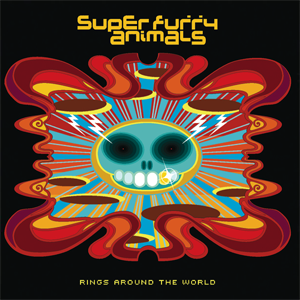
Rings Around the World
If Mwng demonstrated how little interest Super Furry Animals had in playing by conventional commercial rules, Rings Around the World showed that their experimental instincts could also produce their biggest success.
Released in 2001, the album reached No.3 in the UK and was shortlisted for the Mercury Music Prize.
It brought together pop, electronic music, psychedelia, orchestration and increasingly ambitious production on songs including Juxtapozed with U, (Drawing) Rings Around the World and It’s Not the End of the World?
The album was also conceived as a multimedia project, with visual material accompanying its songs – another sign that the band were constantly looking beyond the conventional album format.
For many listeners, Rings Around the World remains the record that best captures the full scope of the band: playful, political, melodic, technologically curious and almost impossible to predict.
***
Phantom Power and Love Kraft
Super Furry Animals followed with Phantom Power in 2003.
The album reached No.4 in the UK and included Golden Retriever and Hello Sunshine, two of the band’s most accessible songs.
Two years later came Love Kraft, recorded partly in Catalunya and mixed in Brazil.
The album reflected a more collaborative approach, with members other than Gruff Rhys taking a greater share of lead vocals and songwriting. Its 20th anniversary was marked with an expanded reissue in 2025.
By this stage, Super Furry Animals had developed a remarkable catalogue without ever settling into a single recognisable formula.
***
The later years
Hey Venus! followed in 2007, before Dark Days/Light Years became the band’s ninth studio album in 2009.
Recorded in Cardiff and released initially through the band’s website, Dark Days/Light Years pushed once again towards heavier grooves, psychedelia and electronic experimentation.
After touring, the band gradually entered a period of inactivity.
Its members pursued other projects, most visibly Gruff Rhys, whose solo career and work with Neon Neon established an extensive body of music outside Super Furry Animals.
The group returned for live performances in 2015 and 2016, before another long pause followed.
For years, Super Furry Animals existed primarily through their catalogue.
Then came 2026.
***
The Furries return
The Supacabra 2026 tour brought the classic five-piece back together on stage for their first full run of concerts in around a decade.
The initial nine dates in Dublin, Glasgow, Llandudno, Cardiff, Manchester and London all sold out, including a Cardiff Utilita Arena show and two nights at Venue Cymru in Llandudno. Further summer dates followed across Britain and Ireland.
The return was accompanied by Precreation Percolation, an archival collection revisiting the group’s earliest material.
Released in May 2026, it brought their original Ankst EPs back into circulation and included previously unheard recordings – most notably Pocket Sam, featuring Rhys Ifans on lead vocals from a 1993 session in Cardiff.
More than 30 years after those early experiments, Super Furry Animals had managed to make their beginnings feel current again.
***
From psychedelic pop to grassroots football
Their 2026 return also produced another typically unexpected crossover.
Super Furry Animals became one of four bands featured on the shirts of Cwmbran Celtic FC for the 2026–27 season, alongside Mogwai, Panic Shack and Loose Articles.
The Furries appear on the men’s home shirt, with part of the proceeds from shirt sales supporting both the football club and the Music Venue Trust.
It is difficult to imagine many other bands whose career could naturally include a Welsh-language Top 20 album, a blue tank, a Hollywood actor, psychedelic pop and a grassroots football shirt.
With Super Furry Animals, it somehow makes perfect sense.
***
Why Super Furry Animals matter
The Cool Cymru years produced several major Welsh success stories.
But Super Furry Animals occupied a space largely of their own.
They were proudly Welsh without allowing themselves to be reduced to a national stereotype. They used the Welsh language naturally within international popular music. They could write straightforward pop songs and then surround them with electronics, political ideas, surreal humour or completely unexpected sounds.
Their records helped demonstrate that Welsh music did not have to choose between being locally rooted and internationally ambitious.
More than three decades after their formation, Super Furry Animals remain one of the most imaginative bands Wales has produced.
And in 2026, the story started moving again.
***
Did Ewe Know?
When Super Furry Animals recorded Rings Around the World, they persuaded Paul McCartney to contribute to the album.
But they didn’t ask him to sing.
They asked a Beatle to chew celery and carrots on Receptacle for the Respectable – a playful nod to McCartney’s earlier vegetable-chewing contribution to the Beach Boys’ Vegetables.