


Silver Age Comics: The Story of Fantastic and Terrific
FANTASTIC debuted in the UK on February 18, 1967, focusing mostly on American Marvel characters like The Mighty Thor, The Invincible Iron Man, and The X-Men. Terrific launched shortly after, on April 15, 1967, with a similar format featuring reprints of The Avengers, Doctor Strange, and Sub-Mariner.
Terrific ran for 43 issues before merging into its sister publication on February 3, 1968, becoming Fantastic and Terrific.
The combined comic later shortened its name back to Fantastic before merging into another Odhams title, Smash!, later in 1968 after 89 total issues.
[*Ed: As a child of the Sixties who adored both Fantastic and Terrific in their original forms – they were my introduction to the world of Marvel, as well as comics themselves – I found these mergers more than a little unsettling and confusing]
While mostly reprint books, Fantastic also featured an original strip called ‘The Missing Link’, which later evolved into the superhero ‘Johnny Future’.
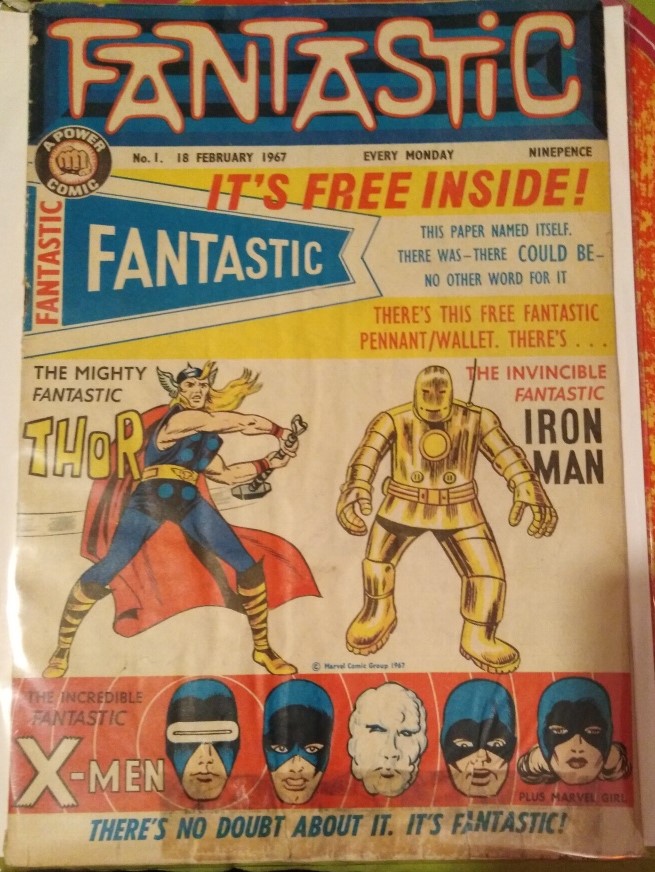
Fantastic was different from the earlier Power Comics such as Smash! and Pow!, which were essentially traditional Beano-style British comic papers supplemented by a small amount of material reprinted from Marvel Comics. By contrast, Fantastic (and later Terrific as well) were more American in appearance, resembling the black-and-white comic anthologies of the time such as Creepy and Eerie.
Thor and Iron Man anchored Fantastic from issue #1, establishing the core Marvel mythos for UK readers. Free gifts made the early issues particularly attractive to young readers eager to part with ninepence of their pocket money, while the full-colour front-cover artwork of the likes of Steve Ditko and Jack Kirby (not forgetting the words of Stan Lee) really packed a punch.
The X-Men – with a line-up of Cyclops, Beast, Angel, Iceman, Jean Grey and Professor X – starred as a primary feature in Fantastic, introducing the concept of mutants to British audiences.
The Avengers & Doctor Strange acted as the lead features for Terrific, showcasing Marvel’s magical and team-up universes. The Sub-Mariner & Nick Fury filled out the pages of Terrific, offering high-seas action and espionage.
Spider-Man appeared in cross-promotions and special features across the Power Comics line-up. Other titles from Odhams were Wham!, Smash! and Pow!
Wham! launched in 1964 as the first Power Comic and mixed traditional British humour with early Marvel reprints like the Fantastic Four.
Smash! debuted in 1966, featuring Batman (DC), the Hulk, and Daredevil, before ultimately absorbing Fantastic in late 1968.
Pow!, released in 1967, focused heavily on Spider-Man and Nick Fury before yet another merger, with Wham!, in 1968.
Stan Lee is said to have used the data from the British Power Comics era to successfully launch Marvel’s own UK division in 1972 with The Mighty World of Marvel.
Fantastic #1, which came with a free pennant flag with interchangeable inserts of various superheroes, had a different format from its three predecessors, being slightly smaller in size and on better paper; it featured 40 pages and a higher cover price (9d, compared to Smash!‘s 7d for 28 pages). This made it three times more expensive than the 3d cover price of DC Thomson’s perennials The Beano (still published to this day) and The Dandy.

All the Marvel strips inside Fantastic were printed in black-and-white, with colour used only for the front and back covers. The first issue commenced with Thor’s origin story from Journey into Mystery #83 (‘The Stone Men from Saturn’), plus the first X-Men story (the arrival of Jean Grey) from the original X-Men #1, and the origin of Iron Man (‘Iron Man is Born’) from Tales of Suspense.
Issue #52 of Fantastic saw the comic re-launched, in effect, as it absorbed companion paper Terrific to form Fantastic and Terrific, featuring Thor and The X-Men (from Fantastic), plus The Avengers and Doctor Strange (from Terrific).
That issue again saw the first of several free gifts given away with each issue. The cover numbering was continued from Fantastic.
The merger of the two titles bought Fantastic another nine months of life, but ultimately this was not enough to save it. Issue #89, published in late October 1968, was the final issue. The Thor strip was thereafter transferred to Smash!, and the others were discontinued.
To match its more American appearance and format, the contents of Fantastic were also predominantly American, starting in the first issue with reprints of Marvel’s The Mighty Thor and The X-Men, as well as Iron Man stories from Tales of Suspense.
Fantastic‘s first 15 weekly issues also featured original stories of a British superhero known as The Missing Link, a prehistoric character closely based on the appearance of The Incredible Hulk. By issue #16, the Missing Link had evolved into a superman of the future, now called Johnny Future. The Johnny Future stories were drawn by Luis Bermejo.
The Thor and X-Men features continued until the end of the comic’s run (when Thor then continued in Smash!), but Iron Man and Johnny Future were replaced by reprints of The Avengers and Doctor Strange, both continuing from Terrific.
A distinctive feature of Fantastic was the full-colour pin-up that appeared on the back cover of most issues. Many of these were reprinted from American Marvel comics, but at least some (including a Johnny Future pin-up) were produced by a young Barry Windsor-Smith.
The Marvel material in the Power Comics titles was frequently edited to replace American spellings and slang with their British equivalents.
Despite the amount of Marvel Comics material in the title, there was a relative lack of credit given to Marvel and the individual American creators of the material used. Marvel credit boxes containing the names of Stan Lee, Steve Ditko, Jack Kirby and the like were invariably deleted from the splash pages; the space they occupied was either left blank or covered with drawn-in artwork.

Apart from the compulsory copyright acknowledgment in small print, the name ‘Marvel’ was never mentioned — wherever it appeared in the strips it was changed to ‘Power’.
In addition to the weekly comics, Fantastic appeared in Summer Special form, containing the pick of Power Comics Fantastic, Smash! and Pow!, in 1968 (cover price 2s/6d), as well as three full-colour Christmas annuals from 1968 (cover price 9s/6d) to 1970.
Nuff said!