
Wales & Australia: A World Apart, a Heritage Shared
MORE than 10,000 miles separate Wales and Australia, yet the connections between the two countries run remarkably deep. From the Welsh miners who helped build Australian communities to a prime minister born in Barry, a global pop superstar with roots in Maesteg and a shared passion for rugby, the ties between these distant nations tell an extraordinary story.
For many Welsh people, Australia represents sunshine, beaches, kangaroos, cricket and a formidable opponent on the rugby field. But scratch beneath the surface and there is a fascinating Welsh presence in Australian history, geography, culture, politics and everyday life.
According to Australia’s 2021 Census, more than 156,000 people identified as having Welsh ancestry, while more than 29,000 Australian residents had been born in Wales. Behind those figures lie generations of migration, adventure and families who carried their Welsh identity halfway around the world.
The connections stretch back to the earliest days of British colonisation. In 1770, Captain James Cook named the eastern coastline of the Australian continent New South Wales, possibly because of its resemblance to the Welsh coastline. The precise reasoning behind his choice remains uncertain, but the name has endured to become one of Australia’s most recognisable geographical identities.
Of course, the land was already home to Aboriginal peoples with their own ancient histories, languages and cultures, long before Europeans arrived. The story of Welsh settlement belongs within that much broader Australian history.
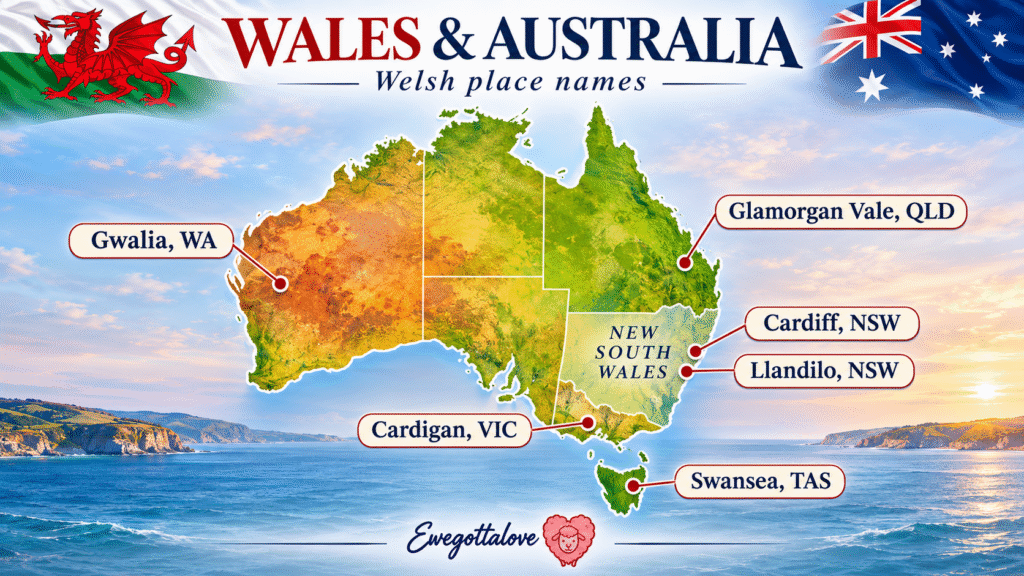
And the Welsh names do not stop with New South Wales. In the Newcastle and Lake Macquarie area, Australians can find their own Cardiff and Swansea, while other familiar Welsh place names have appeared across the continent.
One of the most significant periods in the relationship came during the Australian gold rushes of the 19th Century.
Welsh miners, many already experienced in the coal, slate and metal industries of their homeland, joined thousands of hopeful migrants searching for opportunity in Australia. Victoria became a particularly important destination, with substantial Welsh communities developing around the goldfields of Ballarat and Sebastopol.
They brought far more than their mining skills.
Welsh chapels, choirs, literary societies, newspapers and eisteddfodau helped preserve a sense of national identity thousands of miles from home. In Ballarat, the Welsh language could be heard in places of worship and community gatherings, while the traditions of communal singing and cultural competition found enthusiastic new audiences.
The first Welsh chapel in Melbourne was established in the 1850s. By 1865, more than 20 Welsh chapels had been established across Victoria, demonstrating just how important religion, language and community were to the settlers.
Remarkably, that heritage survives.
Melbourne Welsh Church continues to maintain Welsh traditions, while the Victorian Welsh Choir and other cultural organisations preserve the musical connections between the two countries. Sydney also has its own Welsh choir, bringing traditional and contemporary Welsh music to Australian audiences.
Perhaps the most unusual Welsh connection can be found in the remote goldfields of Western Australia.
Near Leonora stands Gwalia, a former mining settlement named after an old poetic name for Wales. The Sons of Gwalia gold mine was established in the 1890s and developed into one of Australia’s notable gold-producing operations.
Its most famous early manager was a young American mining engineer named Herbert Hoover, who would eventually become the 31st President of the United States.
Today, the preserved mining buildings and cottages of Gwalia offer visitors a glimpse of life in a remote Australian gold-mining settlement, as well as an unexpected reminder of the influence of Welsh migrants.
The Welsh contribution to Australia also reached the highest levels of government.
Julia Gillard, born in Barry in the Vale of Glamorgan in 1961, moved to Australia with her family as a young child. After building a career in law and politics, she became Australia’s 27th prime minister in 2010 and the first woman to hold the office.

She served until 2013, establishing herself as one of the best-known Welsh-born figures in modern Australian history.
Another Australian prime minister, William Morris Hughes, who led the country during the First World War, was born in London to Welsh parents. His family background provides another intriguing link between Wales and Australian political life.
The connections extend into the worlds of music and entertainment.
Australian superstar Kylie Minogue has frequently spoken about her Welsh heritage. Her mother, Carol Jones, comes from a family with roots in Maesteg, in the south Wales valleys, and emigrated to Australia as a child.
The family connection has given Kylie a particularly affectionate relationship with Wales, even though she was born and raised in Melbourne. Her sister Dannii shares the same Welsh ancestry.
There are Welsh links in Australian cinema, too. Acclaimed actress Naomi Watts spent part of her childhood on Anglesey, where her mother’s family lived, before eventually moving to Australia as a teenager. Her remarkable international acting career adds another chapter to the cultural relationship between the two countries.
Sport, naturally, provides some of the most visible connections.
Wales and Australia have been international rugby union opponents since 1908, producing some extraordinary encounters, from the Welsh victory in the inaugural Rugby World Cup’s third-place play-off in 1987 to the remarkable 40-6 Welsh triumph in France in 2023.
But the sporting relationship is broader than rugby. Cricket, football, cycling, swimming and other international sports have provided opportunities for Welsh and Australian competitors to meet, while athletes, coaches and sporting professionals have travelled between the two countries throughout the modern era.

The similarities are not confined to competition.
Both nations have strong agricultural traditions, particularly sheep farming, although the Australian industry operates on a vastly different scale. Sheep and wool have helped shape the economic and cultural identities of both countries, providing another connection between rural Wales and the Australian countryside.
In more recent years, business, education, tourism and creative partnerships have strengthened the relationship.
GlobalWelsh, an organisation connecting Welsh people and businesses around the world, has established an Australian hub to help build professional networks and encourage new commercial opportunities. Such initiatives demonstrate that Welsh identity abroad is not simply a matter of nostalgia, but a living connection with considerable potential for future generations.
There is something especially appealing about the survival of Welsh traditions in a country so far from their origins.
A Welsh hymn sung in Melbourne, a rugby shirt worn in Sydney, a family remembering its roots in Maesteg or a visitor discovering the ghost town of Gwalia: each tells a different story of the enduring relationship between the two countries.
Australia may be almost as far away from Wales as it is possible to travel, but Welsh history, culture and identity have found a remarkable home Down Under.