
Wales and Germany: A Relationship Built on Slate, Lager, Sport and Shared Ideas
THE links between Wales and Germany stretch far beyond football matches and Oktoberfest celebrations.
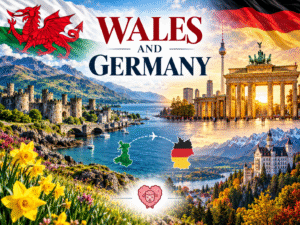
For generations, people, products and ideas have travelled between the two countries — from Welsh slate helping rebuild a German city and German brewers introducing lager to Wrexham, to modern university partnerships, tourism, international trade and Welsh footballers making their mark in the Bundesliga.
Germany has become one of Wales’ most important European connections.
When Welsh slate helped rebuild Hamburg
One of the more remarkable links dates back to the 19th Century.
After the Great Fire of Hamburg in 1842, Welsh slate exported through Porthmadog was used during the rebuilding of the city.
The trade became sufficiently important that sailing ships carried Welsh slate regularly to Germany, helping create commercial and personal links between the two countries. Wales.com records that some Welsh ships were even named after the wives of German slate merchants.
It is an extraordinary reminder that one of Wales’ greatest industrial exports quite literally became part of the fabric of a German city.
***
German brewers create a Welsh institution
The traffic worked in the other direction too.
In 1882, German immigrants Ivan Levinstein and Otto Isler established what became Wrexham Lager.
Their ambition was to reproduce traditional Bavarian lager in Britain, using the naturally cold conditions required for fermentation. When the original cooling arrangements proved insufficient, German-born industrialist Robert Graesser introduced mechanical refrigeration technology.
The result became one of north Wales’ best-known drinks.
Wrexham Lager subsequently developed an international reputation and was reportedly served aboard the Titanic. After disappearing for a period, the brand was revived in 2011 — with new brewing equipment supplied by German engineers.
So the next time somebody raises a glass of Wrexham Lager, there is a little German history inside the story.
***
Major trading partners
The relationship remains economically important today.
Germany was the second-largest destination for Welsh goods exports in 2025, behind only the United States. Wales exported goods worth approximately £2.6 billion to Germany during the year.
Machinery, manufacturing and other industrial sectors have long played an important role in that trade, while German-owned companies have also invested and employed people in Wales.
It is a modern economic relationship built partly upon trading links established many generations earlier.
***
Germans discovering Wales
Germany is also an important source of overseas visitors.
Before the pandemic, around 85,000–87,000 German visitors were travelling to Wales annually, making Germany one of the country’s more significant international tourism markets.
Castles, mountains, coastlines and walking holidays all have obvious appeal, while some German visitors have made Wales their permanent home.
Previous census figures cited by Wales.com put the number of German-born people living in Wales at around 11,000.
***
From Cardiff to Stuttgart
Town twinning has created another network of connections.
Cardiff and Stuttgart have one of the best-known partnerships, with Stuttgart being Cardiff’s oldest twin city.
Elsewhere, Aberystwyth is twinned with Kronberg im Taunus, Swansea with Mannheim, Newport with Heidenheim and Wrexham with Märkischer Kreis.
These relationships have produced exchanges involving schools, musicians, civic groups, businesses and ordinary families.
They demonstrate that international links are not always created by governments. Sometimes they grow one school trip, cultural exchange or friendship at a time.
***
Welsh footballers in Germany
Football has provided some particularly visible connections.
Former Wales striker and manager Mark Hughes played for Bayern Munich during the 1980s, unusually combining his time in Germany with a period at Barcelona.
Later generations followed.
Ethan Ampadu spent a season with RB Leipzig, while Rabbi Matondo joined Schalke 04 after developing in Manchester City’s academy.
Germany therefore occupies an interesting place in the careers of several Welsh internationals — a reminder that the footballing relationship extends beyond occasional meetings between the two national teams.
There is even a rugby connection.
Bridgend-born Jamie Murphy represented Germany internationally in 2017, qualifying through his German grandmother.
***
Universities, science and new ideas
Modern Welsh-German connections increasingly extend into education and research.
Welsh universities have maintained partnerships with German institutions, including links between Cardiff and Bremen and between Bangor University and Johannes Gutenberg University Mainz.
Germany has also been one of Wales’ strongest research partners through the Horizon Europe programme.
German students have regularly studied at Welsh universities, creating another flow of people and ideas between the countries.
***
Music, books and culture
Cultural exchanges have taken Welsh creativity directly into Germany.
The Szene:Wales festival in Dresden in 2018 showcased Welsh theatre and arts, while Welsh writers later appeared at Stuttgart’s Literaturhaus festival.
Welsh bands have also toured Germany extensively over the decades — from the rock groups of the 1970s to contemporary performers — often finding particularly enthusiastic audiences there.
The connection works both ways, with German music, food and cultural traditions increasingly familiar in Wales.
Which brings us back to Oktoberfest.
The sight of Bavarian-style celebrations appearing in Cardiff might seem like a recent novelty, but in reality Wales and Germany have been exchanging traditions, products and ideas for centuries.
***
A relationship still evolving
Slate and coal may no longer dominate Welsh exports. Steamships have given way to airlines and digital communications. But the connection remains.
Today, Wales and Germany trade billions of pounds of goods, collaborate through universities and research institutions, exchange tourists and students, twin their towns and cities and continue to meet on sporting and cultural stages.
The relationship has simply changed with the times.
And among all those connections, perhaps the most wonderfully tangible remains the simplest:
Two German immigrants came to north Wales more than 140 years ago because they wanted to make a proper lager.
Wales has been drinking the result ever since.
***
DID EWE KNOW?
Welsh slate exported through Porthmadog helped rebuild Hamburg after its devastating Great Fire of 1842 — while four decades later German immigrants travelled in the opposite direction and founded Wrexham Lager.