
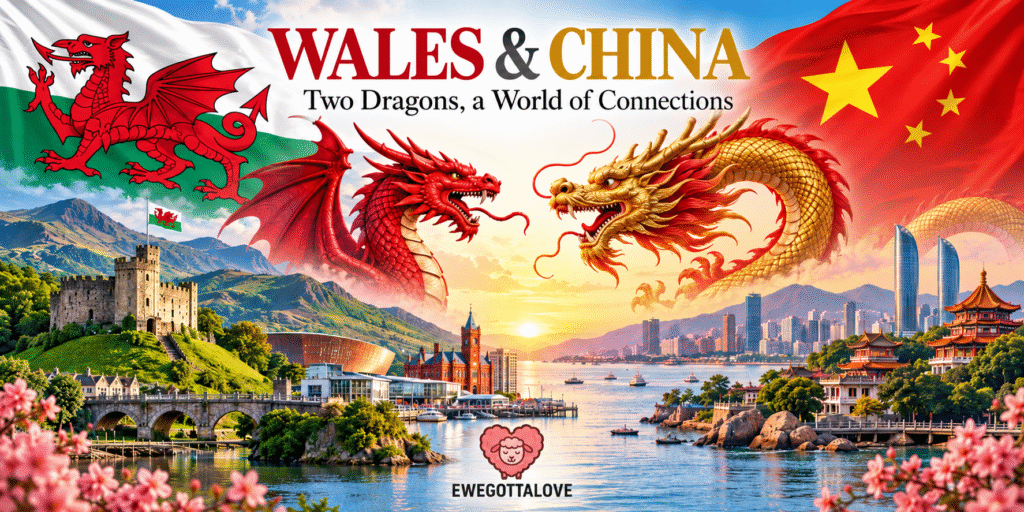
Wales & China – Two Dragons, a World of Connections
欢迎来到威尔士! Welcome to Wales!
Thousands of miles separate Wales and China, yet these two nations share some remarkable connections. From legendary dragons and ancient traditions to historic friendships, cultural exchanges, education, tourism and business partnerships, the relationship between Wales and China offers a fascinating story of two very different countries finding common ground.
Wales may be a relatively small nation on the western edge of Europe, but its distinctive language, history, landscapes, culture and sporting traditions have given it an identity recognised far beyond its borders.
China, home to one of the world’s oldest civilisations, possesses an extraordinary cultural heritage, with traditions and achievements that have influenced societies across the globe.
Despite their considerable differences in geography and population, the two nations have developed lasting relationships through trade, education, cultural exchange and the experiences of people who have travelled between them.
Through Wales & China, Ewegottalove celebrates these connections while inviting Chinese readers to discover more about Wales and its place in the world.
A Tale of Two Dragons
Perhaps the most instantly recognisable connection between Wales and China is a creature that occupies a special place in both cultures – the dragon.
The Welsh Red Dragon, or Y Ddraig Goch, is one of the world’s most distinctive national symbols. Proudly displayed on the Welsh flag, it represents centuries of legend, history and national identity.
According to one famous Welsh legend, a red dragon and a white dragon battled beneath the ground, with the red dragon ultimately emerging victorious. The story became associated with the struggles and identity of the Welsh people.
In China, the dragon holds an equally significant, although very different, position in national culture. Traditionally associated with power, prosperity, good fortune and imperial authority, Chinese dragons have featured in mythology, architecture, festivals and art for thousands of years.
Unlike the fearsome creatures often encountered in Western folklore, traditional Chinese dragons are generally viewed as auspicious beings.
The contrast offers a fascinating illustration of how two cultures can embrace the same mythical creature while developing their own distinctive traditions around it.
For Wales and China, the dragon provides a powerful and appealing symbol of their shared cultural pride.
***
Cardiff and Xiamen – A Pioneering Friendship
One of the most significant modern connections between Wales and China involves their cities.
In 1983, Cardiff became the first city in the United Kingdom to establish a twinning relationship with a Chinese city, when it formed a partnership with Xiamen, a coastal city in China’s Fujian province.
The relationship, formally established on March 31 that year, was intended to encourage closer cultural, educational and commercial connections between the two cities.
More than four decades later, the partnership has developed into something much broader than a ceremonial twinning arrangement.
Cardiff University maintains a strategic partnership with Xiamen University, encouraging academic cooperation, research and student exchanges.
The Cardiff Confucius Institute, launched in 2008, has also contributed to the teaching of Mandarin and the promotion of Chinese language and culture in Wales.
Links have extended into music and further education, bringing together institutions such as the Royal Welsh College of Music & Drama and Xiamen Music School.
The relationship continues to provide opportunities for students, academics, performers and local communities to learn from one another.
Cardiff and Xiamen are both important coastal cities, although their architecture, histories and cultural traditions offer visitors very different experiences.
For visitors from Xiamen, the Welsh capital offers attractions including Cardiff Castle, Cardiff Bay, the Principality Stadium and the city’s historic Victorian shopping arcades.
Xiamen, meanwhile, is celebrated for its maritime heritage, attractive waterfront and the historic island of Gulangyu.
The pioneering relationship between the two cities demonstrates how international friendships can grow through education, culture and personal connections.
***
Swansea, Wuhan and Nantong – Historic Links Across Continents
The city of Swansea has its own remarkable relationships with China, involving two cities and connections stretching back well over a century.
One of the most intriguing figures in this story is Griffith John, born in Swansea in 1831.
John travelled to China in 1855 as a Christian missionary and went on to spend more than half a century working in the country.
He became particularly associated with Hankou, now part of Wuhan, where his activities included establishing schools, training institutions and medical facilities.
His legacy is closely connected with the development of Wuhan Union Hospital, which grew into one of China’s major medical institutions.
A bust of Griffith John, presented to Swansea by Wuhan Union Hospital, is displayed at Swansea Museum, providing a tangible reminder of this extraordinary historical relationship.
The connections continued into modern times.
Swansea and Wuhan signed a sister-city agreement in 2018, encouraging cooperation in education, culture, tourism, trade and other areas.
Swansea University has also developed important partnerships with Wuhan institutions, including collaborative medical research and academic programmes.
Among these is a joint doctoral programme with Wuhan University, providing opportunities for students and researchers to work across both countries.
But Wuhan is not Swansea’s only Chinese connection.
In 1987, Swansea established a twinning relationship with Nantong, a city in Jiangsu province, strengthening opportunities for cultural and commercial cooperation.
The agreement was formally signed on April 10, 1987, following earlier exchanges between representatives of the two cities.
The relationship has also inspired personal friendships and cultural exchanges, reminding us that international partnerships are not simply agreements between governments, but opportunities for ordinary people to discover more about one another.
Together, Swansea’s connections with Wuhan and Nantong represent an important chapter in the wider story of Wales and China.
***
Chinese Communities in Wales
The relationship between Wales and China is also reflected in the people who have made Wales their home.
Chinese communities have contributed to Welsh life through family businesses, restaurants, education, healthcare, commerce, professional services and the arts.
Chinese restaurants and takeaways have long been familiar features of Welsh towns and cities, introducing generations of Welsh families to Chinese cuisine.
Yet the contribution of Chinese communities extends far beyond food, encompassing education, cultural activities, employment and community development.
Organisations such as the Chinese in Wales Association play an important role in celebrating Chinese identity while promoting understanding and friendship between different communities.
A wonderful example came in June 2026, when more than 4,500 people attended Chinese Cultural Heritage Day at St Fagans National Museum of History, near Cardiff.
The celebration featured traditional music and dance, cultural performances, creative workshops and opportunities for visitors to discover Chinese customs and traditions.
Events such as this provide opportunities for people of different backgrounds to come together, sharing experiences and discovering more about the cultures that contribute to modern Welsh life.
***
Chinese New Year, Welsh Traditions and the Land of Song
One of the most colourful expressions of Chinese culture is the Spring Festival, widely known internationally as Chinese New Year.
Associated with family reunions, celebrations, traditional food and hopes for good fortune, it is one of the most important occasions in the Chinese calendar.
Chinese New Year celebrations in Wales have featured lion and dragon dancing, music, craft activities and cultural performances.
There are interesting parallels with the importance Wales places on preserving its own traditions.
The National Eisteddfod of Wales, for example, celebrates Welsh-language poetry, literature, music and performance, while bringing together people from across the country.
Although the occasions have very different origins, both demonstrate the importance of cultural identity and the passing of traditions from one generation to the next.
Wales is famously known as the Land of Song, with a proud musical heritage encompassing male voice choirs, classical performers, folk musicians and internationally successful popular artists.
China possesses its own rich musical traditions, embracing opera, folk music, traditional instruments and contemporary entertainment.
Both countries also have strong storytelling traditions, filled with legendary figures, mythical creatures and tales passed down through the centuries.
These similarities and differences provide endless opportunities for cultural discovery.
***
Studying in Wales – A Warm Welcome for Chinese Students
Education is one of the strongest contemporary links between Wales and China.
Welsh universities welcome international students seeking academic opportunities, research experience and the chance to live and study in another country.
Institutions including Cardiff University, Swansea University, Bangor University, Aberystwyth University, Cardiff Metropolitan University, the University of South Wales, the University of Wales Trinity Saint David and Wrexham University attract students from across the world.
For Chinese students, Wales offers opportunities to study in English while experiencing a country with its own distinctive language, history, traditions and cultural identity.
Students can choose between the lively atmosphere of Cardiff and Swansea, university towns surrounded by mountains and coastline, and campuses offering their own distinctive environments.
Academic partnerships between Welsh and Chinese institutions also encourage research collaboration, student exchanges and international understanding.
Through Ewegottalove’s dedicated Studying in Wales section, prospective students and their families can discover more about Welsh universities, their locations, academic strengths and the experience of living in Wales.
***
Discover Wales – A Country of Castles, Coastlines and Mountains
For Chinese visitors exploring Britain, Wales offers a wealth of attractions that are sometimes overlooked in favour of larger and more internationally familiar destinations.
Yet this compact country possesses some of Europe’s most striking landscapes, an extraordinary collection of castles and a rich cultural identity.
The capital, Cardiff, combines a historic castle, modern shopping, international sporting occasions, live entertainment and the waterfront attractions of Cardiff Bay.
In north Wales, the mountains of Eryri (Snowdonia) provide spectacular scenery, while the surrounding region is famous for its medieval fortresses, including Caernarfon Castle, Conwy Castle and Harlech Castle.
The coastline of Pembrokeshire offers dramatic cliffs, sandy beaches, picturesque harbours and opportunities to explore the outdoors.
Further inland, Bannau Brycheiniog (Brecon Beacons) attracts visitors with its mountain scenery, waterfalls and walking routes.
Visitors interested in industrial history can discover how Welsh coal and steel helped shape modern Britain and contributed to international trade.
At Big Pit National Coal Museum, visitors can experience an important part of the country’s mining heritage.
Historic steam railways, traditional markets, coastal towns, gardens, museums and cultural festivals provide countless other reasons to explore.
And wherever visitors travel, they will encounter the Welsh language – Cymraeg – one of Europe’s living Celtic languages and a central part of Welsh identity.
For visitors from China, Wales offers an opportunity to discover somewhere with its own distinctive character within the wider British experience.
***
Welsh Sport – From Rugby & Football to Snooker
Sport provides another connection between countries and cultures.
Wales is internationally associated with rugby union, while football has become an increasingly prominent part of the country’s global sporting identity.
The Welsh national football team has attracted worldwide attention through appearances in major international tournaments, while clubs such as Cardiff City, Swansea City and Wrexham AFC have introduced Welsh football to international audiences.

Many Cardiff City fans, in particular, will remember the only Chinese player to have played senior club football in Wales, Fan Zhiyi (范志毅). The former China national team captain and 2001 Asian Player of the Year signed for the Bluebirds on a short-term contract in November 2002 after leaving Scottish club Dundee. He made six league appearances for Cardiff during the 2003 season.
But one sport offers a particularly appealing connection between Wales and China – snooker.
Wales has produced some of the game’s greatest champions, including Ray Reardon, Terry Griffiths and Mark Williams.
China has become a major force in international snooker, producing outstanding players and attracting enormous interest in the sport.
For Chinese snooker enthusiasts, the careers and achievements of Welsh champions offer an excellent introduction to another aspect of Welsh sporting history.
Ewegottalove’s Sport in Wales section explores these achievements alongside Welsh rugby, football, boxing, golf, cycling and many other sports.
***
Business, Innovation and International Opportunities
Wales and China also share connections through business, trade, manufacturing, education and technological development.
Wales has a proud industrial history, particularly in coal, iron and steel, but its modern economy encompasses advanced manufacturing, research, renewable energy, creative industries and life sciences.
Chinese businesses and institutions have developed links with Welsh organisations, while university partnerships have encouraged international research and innovation.
The relationships between Cardiff and Xiamen, and Swansea with Wuhan and Nantong, illustrate how connections between cities can create opportunities for commercial as well as cultural co-operation.
For Chinese businesses exploring potential opportunities in Wales, understanding the country’s universities, industries, infrastructure and regional economies can provide a useful starting point.
Ewegottalove’s Business in Wales section introduces some of the companies, industries and entrepreneurs contributing to the Welsh economy.
***
Wales Around the World – A Global Welsh Welcome
Wales has always been a country with connections reaching far beyond its borders.
Welsh emigrants have established communities throughout the world, while international visitors, students, businesses and families have contributed enormously to life in Wales.
China forms an important part of this wider story.
From 19th-Century travellers and missionaries to modern university partnerships, sister-city relationships and cultural celebrations, the connections between the two countries have developed across generations.
The friendship between Cardiff and Xiamen, the historical ties between Swansea and Wuhan, the twinning of Swansea and Nantong, and the contributions of Chinese communities in Wales all demonstrate how international relationships can bring people together.
Through Wales Around the World, Ewegottalove celebrates these stories and encourages people from different countries to discover what makes Wales special.
Whether you are planning a visit, considering studying in Wales, exploring business opportunities, researching family connections or simply curious about Welsh history and culture, we hope this page offers a welcoming introduction.
欢迎探索威尔士,发现威尔士与中国之间的精彩联系!
Welcome to Wales – discover the fascinating connections between Wales and China!
***
Did Ewe Know?
A Chinese painting presented to a Swansea couple in 1989 helped bring about an extraordinary reunion 37 years later.
The artwork, Spring Scenery, was painted by 14-year-old Feng Yan and given to the couple during a visit to Nantong, Swansea’s Chinese twin city.
In March 2026, a social media appeal helped reunite the couple with the artist, now a professional painter. Feng subsequently created another artwork featuring landmarks from Nantong and Swansea – a fitting celebration of a friendship spanning continents and generations.
POP CULTURE: Welsh Mythology Goes Global as Chinese Video Game Introduces Rhiannon